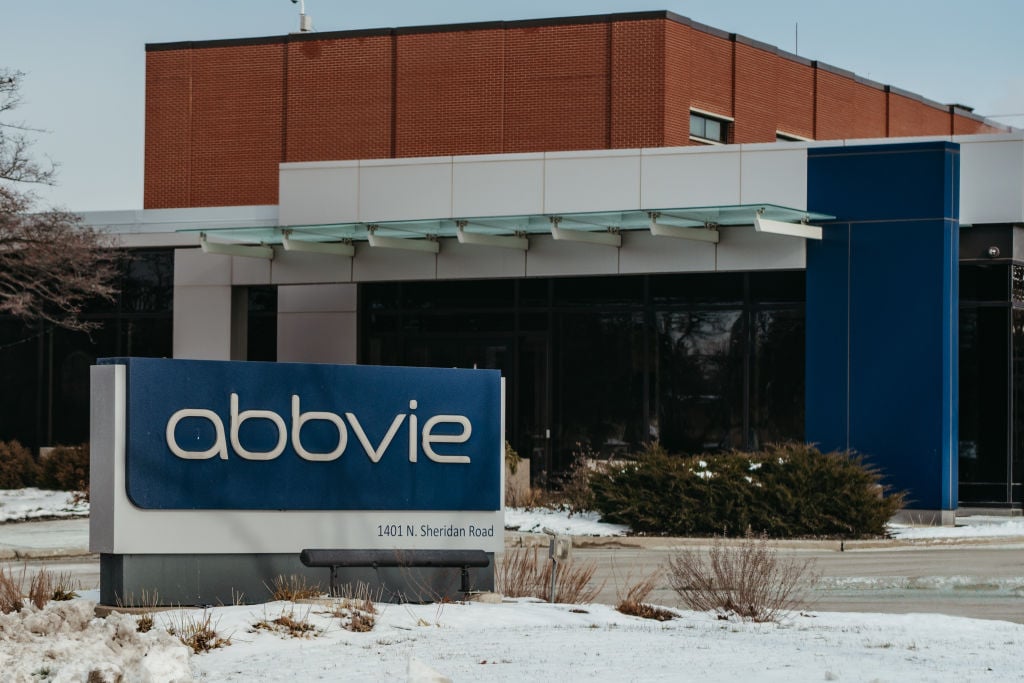
AbbVie is a pharmaceutical firm with a strong exposure to immunology (with Humira, Skyrizi, and Rinvoq) and oncology (with Imbruvica and Venclexta). The company was spun off from Abbott in early 2013. The 2020 acquisition of Allergan added several new products and drugs in aesthetics, including Botox. The 2024 acquisitions of Cerevel (neuroscience) and ImmunoGen (oncology) help supplement AbbVie's portfolio.
The chart shows the growth of an initial investment of $10,000 in ABBVIE INC., comparing it to the performance of the S&P 500 index. All prices have been adjusted for splits and dividends.
Returns By Period
ABBVIE INC. (ABBV) has returned -8.70% so far this year and 15.36% over the past 12 months. Looking at the last ten years, ABBV has achieved an annualized return of 13.74%, outperforming the Benchmark (SPY), which averaged 12.23% per year.
ABBV
1M-10.53%
6M-9.87%
YTD-8.70%
1Y15.36%
5Y14.14%
10Y13.74%
Benchmark (SPY)
1M-3.85%
6M-2.35%
YTD-4.36%
1Y34.06%
5Y9.80%
10Y12.23%
Monthly Returns
The table below presents the monthly returns of ABBVIE INC. (ABBV) with color gradation from worst to best to easily spot seasonal factors.
Jan
Feb
Mar
Apr
May
Jun
Jul
Aug
Sep
Oct
Nov
Dec
2026
-2.51%
3.22%
-6.92%
-4.36%
2025
2.93%
14.11%
-0.22%
-7.32%
-3.51%
-0.06%
2.17%
10.78%
10.18%
-6.68%
5.09%
0.57%
2024
6.13%
7.54%
3.44%
-10.58%
-0.52%
7.20%
8.20%
4.55%
0.68%
3.15%
-10.49%
-2.51%
2023
-8.82%
4.96%
4.33%
-4.51%
-8.54%
-0.39%
11.63%
-2.03%
1.15%
-4.91%
0.37%
8.72%
2022
1.09%
7.57%
9.78%
-9.42%
0.49%
3.63%
-6.25%
-4.98%
-0.32%
7.74%
9.90%
0.38%
2021
-4.39%
4.60%
-0.29%
2.37%
0.71%
-0.93%
2.97%
3.33%
-10.85%
5.93%
0.03%
16.95%
2020
-9.05%
5.41%
-11.41%
13.98%
13.08%
6.66%
-3.64%
0.61%
-8.30%
-3.48%
21.56%
2.00%
2019
-12.00%
-1.26%
1.03%
-1.96%
-3.63%
-5.10%
-9.36%
-1.78%
15.11%
4.82%
9.62%
0.80%
2018
15.52%
3.20%
-18.34%
2.71%
-3.10%
-5.39%
0.18%
4.00%
-1.45%
-17.83%
21.31%
-2.26%
2017
-2.88%
1.26%
4.83%
1.07%
0.03%
9.44%
-3.92%
7.53%
17.56%
0.57%
6.76%
-0.49%
2016
7.81%
3.52%
-1.57%
6.86%
-3.22%
-1.61%
-11.49%
8.57%
2.94%
Performance Indicators
The charts below present risk-adjusted performance metrics for ABBVIE INC. (ABBV) and compare them to a Benchmark (SPY). These indicators evaluate an investment's returns against its associated risks.
Sharpe ratio
Sortino ratio
Omega ratio
Calmar ratio
Martin ratio
sharpe ratio
The Sharpe ratio helps investors understand how much return they're getting for the level of risk taken. A higher Sharpe ratio indicates better risk-adjusted performance, meaning more reward for each unit of risk.
These values reflect how efficiently the investment has delivered returns relative to its volatility over different time periods. All figures are annualized and based on daily total returns.
The chart below shows the rolling Sharpe ratio of ABBV compared to the benchmark. This view highlights how the investment's risk-adjusted performance has changed over time.
Volatility Chart
The current ABBVIE INC. volatility is 1.65%, representing the standart deviation of percentage change in the investments's value, either up or down over the past month. The chart below shows the rolling one-month volatility.
Drawdowns Chart
The Drawdowns chart displays portfolio losses from any high point along the way. It shows the maximum percentage drop from a peak to a trough over a specified period, indicating the risk of significant losses. Although chart shows positive values, it represents the percentage drop from the peak, so a value of 10% means the portfolio has dropped 10% from its highest point.
Income Statement
The income statement provides a summary of a company's revenues, expenses, and profits over a specific period. It shows how much money the company earned (revenues) and how much it spent (expenses), leading to the net income or profit. This statement is crucial for understanding a company's financial performance and profitability.
2025
2023
2022
2021
2020
2019
2018
2017
2016
2015
2014
2013
Liabilities And Equity (USD)
133.96B
134.71B
138.81B
146.53B
150.57B
89.12B
59.35B
70.79B
66.10B
53.05B
27.55B
29.20B
Equity Attributable To Parent (USD)
-3.27B
10.36B
17.25B
15.41B
13.08B
-8.17B
-8.45B
5.10B
4.64B
3.95B
1.74B
4.49B
Equity Attributable To Noncontrolling Interest (USD)
As tech stocks decline and recession fears grow, investors are rotating into defensive healthcare stocks. AbbVie and Amgen are recommended as stable dividend-paying pharmaceutical companies with strong product portfolios and reliable dividend histories that can weather economic downturns.
The Motley Fool•Prosper Junior Bakiny
AI Insight
Strong drug portfolio across multiple therapeutic areas (Skyrizi, Rinvoq, Botox), Dividend King status with 50+ consecutive annual payout increases, management guidance increases for key products, and expected $31 billion in combined sales for Skyrizi and Rinvoq by 2026 make it an attractive defensive pick.
The spinal cord injury treatment market is experiencing significant expansion with multiple emerging therapies in development. Currently valued at USD 354 million in 2025, the market is projected to grow to USD 1.4 billion by 2034 at a 15.4% CAGR. Six key therapies are highlighted: KP-100IT (hepatocyte growth factor), Neuro-Cells (stem cell therapy), MT-3921 (RGMa inhibitor), Elezanumab (RGMa inhibitor), NFX88 (neuropathic pain relief), and NVG-291 (neurorepair peptide). These innovations address a critical unmet medical need, as STEMIRAC remains the only approved disease-modifying treatment, available exclusively in Japan.
GlobeNewswire Inc.•Delveinsight
AI Insight
Elezanumab received FDA Orphan Drug and Fast Track designations. Projected highest single-asset market revenue of USD 437 million by 2034, positioning it as major competitive opportunity.
Merck announced its acquisition of Terns Pharmaceutical for $6.7 billion to bolster its cancer treatment pipeline with TERN-701, an oral BCR-ABL1 inhibitor for chronic myeloid leukemia. This marks the third multi-billion-dollar acquisition in a year, reinforcing Merck's M&A strategy. The company has a strong earnings track record, forecasts over $70 billion in commercial opportunity by mid-2030s, maintains a 73% gross margin, and has increased dividends for 14 consecutive years.
Investing.com•Jessica Mitacek
AI Insight
Mentioned only as a market cap comparison point ($370 billion). No specific news or developments regarding the company are discussed in the article.
Over 120 pharmaceutical companies are actively developing 140+ pipeline drugs for systemic lupus erythematosus (SLE), with approximately 30+ drugs in mid-stage development and 85+ in early stages. Key players include Roche, Biogen, Novartis, AbbVie, and Johnson & Johnson, with promising therapies targeting various mechanisms such as B cell inhibitors, JAK inhibitors, and TLR antagonists. Recent regulatory milestones include FDA Fast Track designation for nipocalimab and Breakthrough Therapy Designation for litifilimab.
GlobeNewswire Inc.•Delveinsight
AI Insight
AbbVie is developing ABBV 599 (Phase II) for SLE, but no recent clinical trial results or regulatory updates are provided in the article.
The Schwab U.S. Dividend Equity ETF (SCHD) completed its annual reconstitution, adding UnitedHealth and Abbott Laboratories while removing AbbVie. These changes increased the fund's healthcare sector allocation from 15.4% to 18.9%, making it the second-largest sector weighting. The new holdings have a higher average dividend growth rate (9.4% vs 8.6%), which should generate more income and potentially higher total returns for investors over time.
The Motley Fool•Matt Dilallo
AI Insight
Removed from the ETF despite being a quality dividend stock with consistent 5.5% annual increases and 3.3% yield, but replaced due to slower growth relative to new holdings.
The global bile duct cancer market is projected to expand from $2.59 billion in 2025 to $3.89 billion by 2030, growing at an 8.4% CAGR. Growth is driven by advancements in early diagnostics, increased adoption of immunotherapy and targeted therapies, AI-assisted diagnostics, and rising prevalence of liver diseases. Major pharmaceutical companies are introducing innovative treatments and forming strategic partnerships to enhance patient outcomes.
GlobeNewswire Inc.•Researchandmarkets.Com
AI Insight
Listed as a key market player dominating the bile duct cancer market, positioning the company to benefit from the projected 8.4% CAGR growth through 2030.
AbbVie and Bristol Myers Squibb are highlighted as exceptions in the healthcare sector, offering above-average dividend yields and consistent dividend growth. AbbVie, a Dividend King with a 3.4% yield, has successfully transitioned from its blockbuster drug Humira to new treatments Skyrizi and Rinvoq. Bristol Myers Squibb, yielding 4.4%, is navigating patent cliffs through innovation in its oncology portfolio, making both attractive for patient, buy-and-hold dividend investors.
The Motley Fool•Eric Volkman
AI Insight
Recognized as a Dividend King with 50+ years of consecutive annual dividend raises. Strong fundamentals with blockbuster drugs Skyrizi and Rinvoq generating $7.4B in quarterly revenue. Robust free cash flow supports sustainable dividend growth at 3.4% yield.
AbbVie stock has underperformed the market this year, down 11% amid healthcare sector headwinds. However, the company demonstrates strong fundamentals with accelerating growth, successful new immunology drugs (Skyrizi and Rinvoq) offsetting Humira patent losses, and a modest forward P/E ratio of 14. With a PEG multiple of 0.49 and a 3.4% dividend yield, the stock appears undervalued for long-term investors.
The Motley Fool•David Jagielski, Cpa
AI Insight
The article highlights AbbVie's strong financial metrics (9% revenue growth, accelerating growth rate), successful product pipeline (Skyrizi and Rinvoq generating $25.9B), attractive valuation (P/E of 14 vs S&P 500 average of 21, PEG of 0.49), and above-average dividend yield of 3.4%. Despite recent underperformance, these fundamentals suggest significant upside potential.
The Schwab U.S. Dividend Equity ETF (SCHD) is recommended as a high-quality dividend ETF that avoids dividend yield traps through strict inclusion criteria requiring 10+ years of consecutive dividend increases, strong cash flow, and high return on equity. With a 3.1% average dividend yield and 12.5% average annual returns over the past decade, the ETF offers a diversified portfolio across defensive sectors including energy, consumer staples, and healthcare.
The Motley Fool•Stefon Walters
AI Insight
Listed as a notable holding in SCHD, representing the healthcare sector with proven dividend sustainability.
Following recent market pullbacks, two healthcare stocks stand out as recovery opportunities: CVS Health, which faces Medicare Advantage reimbursement pressures but benefits from its diversified business model, and AbbVie, whose strong-performing immunology drugs Skyrizi and Rinvoq are offsetting Humira's patent-driven decline while maintaining a 54-year dividend increase streak.
The Motley Fool•Prosper Junior Bakiny
AI Insight
Strong performance from core growth drivers Skyrizi and Rinvoq (combined $31B+ expected sales), promising pipeline candidates like emraclidine, steady progress in other products, and 54-year dividend increase history make it attractive despite recent stock volatility and Humira patent concerns.