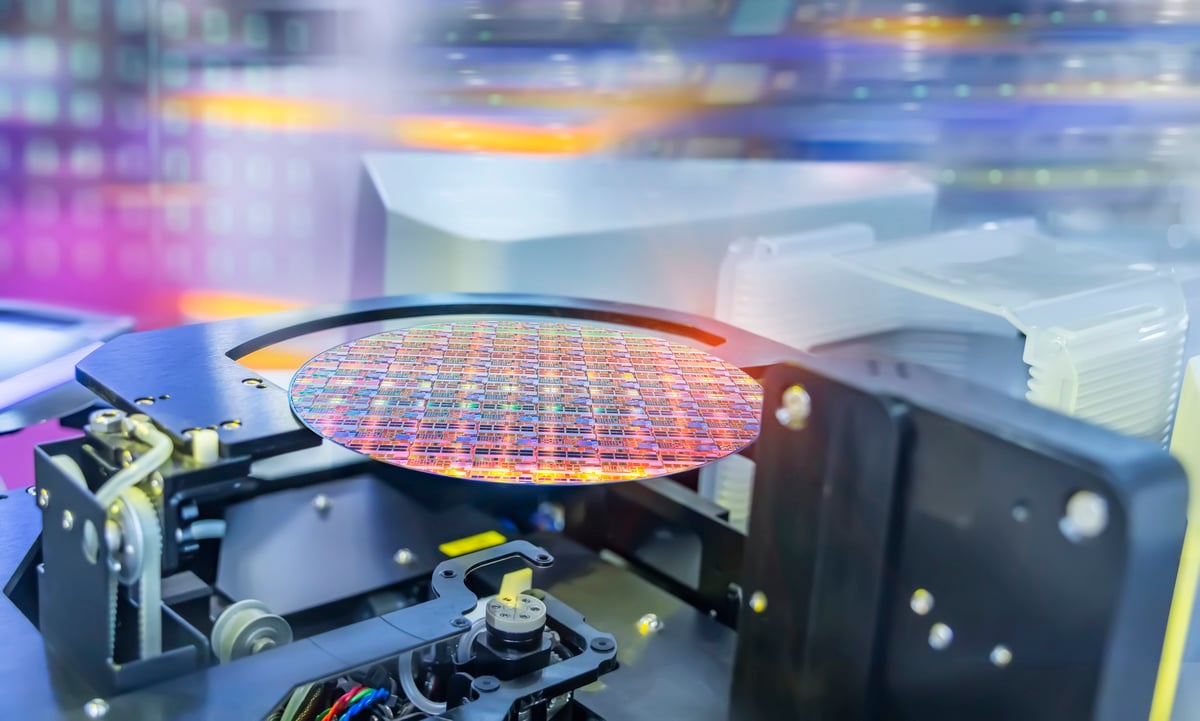
Dallas-based Texas Instruments generates over 95% of its revenue from semiconductors and the remainder from its well-known calculators. Texas Instruments is the world's largest maker of analog chips, which are used to process real-world signals such as sound and power. Texas Instruments also has a leading market share position in processors and microcontrollers used in a wide variety of electronics applications.
The chart shows the growth of an initial investment of $10,000 in Texas Instruments Incorporated, comparing it to the performance of the S&P 500 index. All prices have been adjusted for splits and dividends.
Returns By Period
Texas Instruments Incorporated (TXN) has returned 11.38% so far this year and 29.13% over the past 12 months. Looking at the last ten years, TXN has achieved an annualized return of 12.92%, outperforming the Benchmark (SPY), which averaged 12.23% per year.
TXN
1M-3.01%
6M7.66%
YTD11.38%
1Y29.13%
5Y0.23%
10Y12.92%
Benchmark (SPY)
1M-3.85%
6M-2.35%
YTD-4.36%
1Y34.06%
5Y9.80%
10Y12.23%
Monthly Returns
The table below presents the monthly returns of Texas Instruments Incorporated (TXN) with color gradation from worst to best to easily spot seasonal factors.
Jan
Feb
Mar
Apr
May
Jun
Jul
Aug
Sep
Oct
Nov
Dec
2026
23.20%
-1.54%
-8.01%
0.30%
2025
-2.49%
7.08%
-9.70%
-10.73%
13.68%
14.17%
-12.53%
12.72%
-7.85%
-11.27%
3.65%
3.99%
2024
-5.17%
5.09%
3.97%
1.32%
10.90%
-0.94%
5.26%
6.24%
-2.54%
-1.41%
-1.01%
-6.14%
2023
5.97%
-3.14%
8.75%
-9.78%
3.37%
2.36%
-0.09%
-6.11%
-6.45%
-10.97%
7.06%
11.33%
2022
-4.94%
-5.35%
8.34%
-7.69%
3.64%
-13.44%
18.98%
-7.15%
-5.25%
2.05%
11.23%
-8.23%
2021
0.66%
2.93%
8.30%
-5.55%
4.59%
0.48%
-0.73%
-0.77%
0.23%
-3.08%
3.02%
-3.71%
2020
-6.57%
-5.72%
-13.23%
20.78%
5.66%
7.81%
0.75%
10.92%
-0.15%
-0.58%
10.10%
0.92%
2019
8.54%
5.20%
-0.74%
9.11%
-11.65%
9.25%
6.30%
-1.47%
5.03%
-9.24%
0.86%
6.80%
2018
4.34%
-0.37%
-4.63%
-1.39%
10.69%
-2.04%
2.18%
1.12%
-3.36%
-13.78%
6.93%
-7.80%
2017
2.73%
0.74%
4.45%
-2.09%
4.09%
-6.88%
5.07%
1.50%
8.34%
7.58%
0.33%
8.18%
2016
-0.78%
5.76%
3.54%
11.90%
-0.42%
2.04%
1.10%
3.94%
-1.23%
Performance Indicators
The charts below present risk-adjusted performance metrics for Texas Instruments Incorporated (TXN) and compare them to a Benchmark (SPY). These indicators evaluate an investment's returns against its associated risks.
Sharpe ratio
Sortino ratio
Omega ratio
Calmar ratio
Martin ratio
sharpe ratio
The Sharpe ratio helps investors understand how much return they're getting for the level of risk taken. A higher Sharpe ratio indicates better risk-adjusted performance, meaning more reward for each unit of risk.
These values reflect how efficiently the investment has delivered returns relative to its volatility over different time periods. All figures are annualized and based on daily total returns.
The chart below shows the rolling Sharpe ratio of TXN compared to the benchmark. This view highlights how the investment's risk-adjusted performance has changed over time.
Volatility Chart
The current Texas Instruments Incorporated volatility is 1.97%, representing the standart deviation of percentage change in the investments's value, either up or down over the past month. The chart below shows the rolling one-month volatility.
Drawdowns Chart
The Drawdowns chart displays portfolio losses from any high point along the way. It shows the maximum percentage drop from a peak to a trough over a specified period, indicating the risk of significant losses. Although chart shows positive values, it represents the percentage drop from the peak, so a value of 10% means the portfolio has dropped 10% from its highest point.
Income Statement
The income statement provides a summary of a company's revenues, expenses, and profits over a specific period. It shows how much money the company earned (revenues) and how much it spent (expenses), leading to the net income or profit. This statement is crucial for understanding a company's financial performance and profitability.
2025
2023
2022
2021
2020
2019
2018
2017
2016
2015
2014
2013
2012
2011
Liabilities And Equity (USD)
34.59B
32.35B
27.21B
24.68B
19.35B
18.02B
17.14B
17.64B
16.43B
16.23B
17.72B
18.94B
20.02B
20.50B
Equity Attributable To Parent (USD)
16.27B
16.90B
14.58B
13.33B
9.19B
8.91B
8.99B
10.34B
10.47B
9.95B
10.39B
10.81B
10.96B
10.95B
Equity Attributable To Noncontrolling Interest (USD)
Questex's Sensors Converge and Fierce Sensors announced the 2026 Best of Sensors Awards finalists, recognizing innovative technologies and companies shaping the future of sensing and electronics. The awards will be presented at Sensors Converge 2026, taking place May 5-7 at the Santa Clara Convention Center. Finalists span multiple categories including product innovation, MEMS solutions, IoT connectivity, and individual excellence awards.
GlobeNewswire Inc.•Questex
AI Insight
Company of the Year finalist with finalists in automotive, instrumentation, and power solutions categories
Texas Instruments, an analog chipmaker often overlooked in favor of AI chip stocks, offers an attractive 3% dividend yield and has increased dividends for 22 consecutive years. The author predicts it will eventually become a Dividend King, arguing that while its chips are 'boring,' they are essential to the digital transition and support critical infrastructure including AI data centers and consumer electronics.
The Motley Fool•Reuben Gregg Brewer
AI Insight
Author makes a bold bullish call, highlighting attractive 3% dividend yield, 22-year dividend increase streak, essential role in digital infrastructure, and potential to become a Dividend King. Strong fundamentals with 70% YoY sales growth to data centers.
The U.S. AI in electronics and sensors market is valued at USD 4.44B in 2025 and is projected to grow at a 20.72% CAGR through 2035, reaching nearly USD 29.15B. Growth is driven by autonomous vehicles, industrial automation, healthcare devices, IoT, edge computing, and smart manufacturing. MEMS sensors lead the market with 35% share, while automotive applications account for 30% of the market. North America dominates with 36% market share, while Asia-Pacific is the fastest-growing region with a 26.31% CAGR.
GlobeNewswire Inc.•Sns Insider
AI Insight
Listed as a leading market player with significant presence in North America, benefiting from high penetration of AI sensors in automotive, industrial, and consumer electronics applications.
While chip stocks like Nvidia have dominated AI investment gains, Vertiv Holdings offers an alternative way to capitalize on AI infrastructure growth through data center power and cooling systems. With 252% YOY organic order growth, a $15 billion backlog, and expectations for continued expansion as data center spending is projected to quadruple by 2030, Vertiv presents a compelling non-chip AI play despite its elevated P/E ratio.
The Motley Fool•John Bromels
AI Insight
Analog chipmaker up 21% year-to-date, participating in the broader AI-driven semiconductor sector growth.
The article recommends three reliable dividend stocks for $1,000 investments: Realty Income (4.9% yield, 30-year dividend increase streak), Enterprise Products Partners (6% yield, 27-year distribution increase history), and Texas Instruments (2.6% yield, 22-year dividend hike record). All three are characterized as slow-growth, stable businesses suitable for long-term income generation.
The Motley Fool•Reuben Gregg Brewer
AI Insight
Recommended despite lower 2.6% yield due to 22-year dividend increase history, strong position in analog chips with growing demand from digitalization and AI, recent 70% year-over-year data center sales growth, and strategic capital investments positioning for future growth.
The article highlights Taiwan Semiconductor Manufacturing (TSM) as a critical but overlooked player in the global AI revolution. Founded in 1987 by Morris Chang, TSM pioneered the foundry-based semiconductor business model, allowing design companies to specialize while TSM handled manufacturing. The company has become essential to major tech firms and benefits from long-term trends like digital transformation, cloud computing, and artificial intelligence.
The Motley Fool•Dan Caplinger
AI Insight
Mentioned only as Morris Chang's former employer where he developed semiconductor expertise before founding TSM. No investment thesis or forward-looking commentary provided.
The global power transistor market is valued at $16.26 billion in 2025 and is expected to grow to $42.02 billion by 2035 at a CAGR of 9.96%. Growth is driven by rising EV adoption, renewable energy integration, and demand for energy-efficient power electronics. Asia Pacific leads with 39.4% market share, while the automotive segment is the fastest-growing end-use sector. Manufacturing complexity with wide-bandgap materials like SiC and GaN remains a key constraint.
GlobeNewswire Inc.•Sns Insider
AI Insight
Identified as a key market player benefiting from growing demand for power transistors across consumer electronics, automotive, and industrial automation segments.
Texas Instruments, an analog chipmaker, is positioned to be a major beneficiary of the AI infrastructure buildout. The company's chips provide critical power management functions in data centers. With a newly separated data center segment that grew 64% year-over-year and recent acquisition of Silicon Labs, Texas Instruments could emerge as a top-performing chipmaker by 2027.
The Motley Fool•Reuben Gregg Brewer
AI Insight
The article highlights TXN's strategic positioning in the AI buildout with its power management chips, strong 64% YoY growth in the newly separated data center segment, recent acquisition of Silicon Labs to expand capacity, and potential to become a top performer by 2027.
Vanguard Dividend Appreciation ETF (VIG) and Schwab U.S. Dividend Equity ETF (SCHD) are compared as dividend-focused investment options. SCHD offers a higher dividend yield of 3.5% versus VIG's 1.6%, driven by greater exposure to energy and consumer defensive stocks. However, VIG has delivered stronger capital appreciation with a 10.4% one-year return compared to SCHD's 6.6%, benefiting from heavier technology and financial services exposure. Both funds have nearly identical low expense ratios and substantial assets under management.
The Motley Fool•Jake Lerch
AI Insight
Texas Instruments is a top SCHD holding mentioned for portfolio composition. No independent sentiment is provided.
The Vulnerable Road User (VRU) RF sensing platform market is experiencing significant growth, valued at $2.1 billion in 2024 and projected to reach over $6 billion by 2033 at a 14% CAGR. VisionWave demonstrated SaverOne's RF-based VRU detection platform's ability to detect pedestrians in challenging conditions including darkness and obstructed views. Key industry players are advancing radar and AI-based perception technologies for autonomous vehicles and smart city infrastructure.
Benzinga•Prnewswire
AI Insight
Acquiring Silicon Labs for $7.5 billion to create global leader in embedded wireless connectivity; combining strong portfolios to accelerate growth and innovation in mixed-signal solutions.