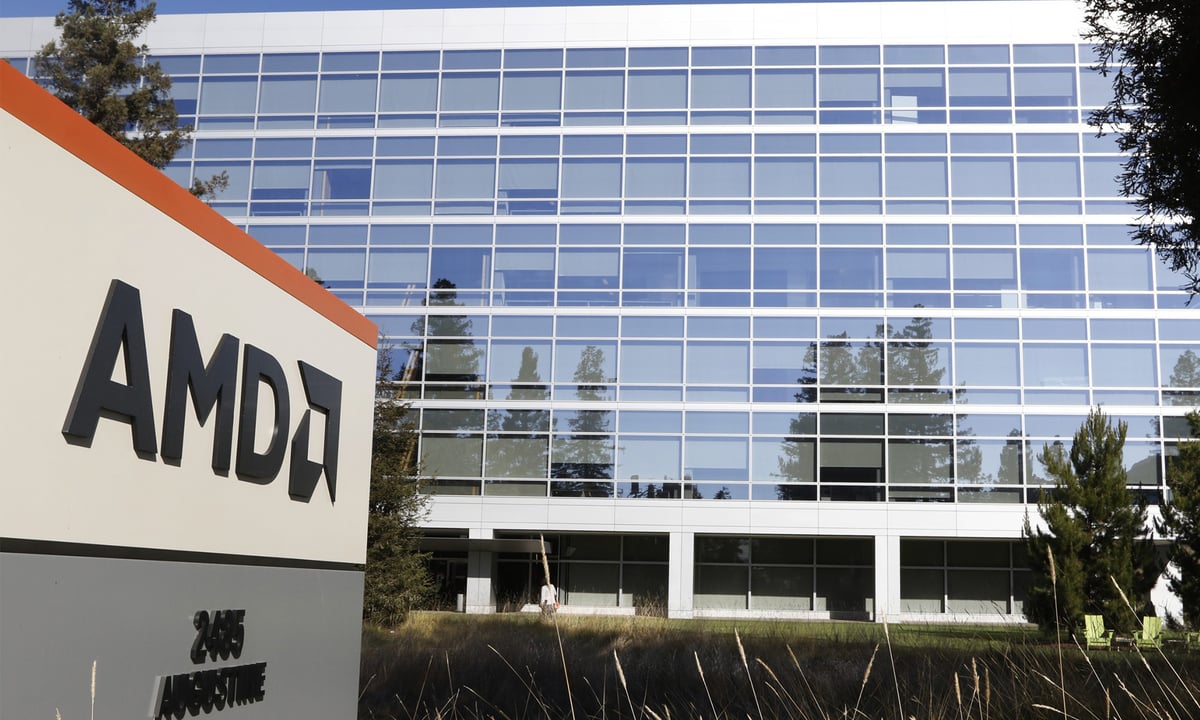
Advanced Micro Devices designs a variety of digital semiconductors for markets such as PCs, gaming consoles, data centers (including artificial intelligence), industrial, and automotive applications. AMD's traditional strength was in central processing units and graphics processing units used in PCs and data centers. However, AMD is emerging as a prominent player in AI GPUs and related hardware. Additionally, the firm supplies the chips found in prominent game consoles such as the Sony PlayStation and Microsoft Xbox.
The chart shows the growth of an initial investment of $10,000 in Advanced Micro Devices, comparing it to the performance of the S&P 500 index. All prices have been adjusted for splits and dividends.
Returns By Period
Advanced Micro Devices (AMD) has returned -0.64% so far this year and 141.40% over the past 12 months. Looking at the last ten years, AMD has achieved an annualized return of 54.37%, outperforming the Benchmark (SPY), which averaged 12.23% per year.
AMD
1M13.21%
6M-3.95%
YTD-0.64%
1Y141.40%
5Y21.62%
10Y54.37%
Benchmark (SPY)
1M-3.79%
6M-2.35%
YTD-4.36%
1Y25.24%
5Y10.20%
10Y12.23%
Monthly Returns
The table below presents the monthly returns of Advanced Micro Devices (AMD) with color gradation from worst to best to easily spot seasonal factors.
Jan
Feb
Mar
Apr
May
Jun
Jul
Aug
Sep
Oct
Nov
Dec
2026
8.15%
-15.08%
4.94%
4.78%
2025
-5.18%
-12.31%
1.21%
-4.71%
11.55%
27.77%
27.05%
-4.43%
2.13%
59.15%
-16.12%
0.13%
2024
16.23%
13.74%
-8.80%
-12.06%
12.69%
-5.04%
-10.40%
2.46%
12.07%
-12.41%
-5.03%
-12.42%
2023
13.87%
0.14%
24.77%
-7.58%
29.86%
-2.88%
-0.66%
-7.47%
-3.91%
-3.63%
22.91%
22.96%
2022
-21.28%
5.64%
-10.62%
-22.59%
18.92%
-25.12%
25.65%
-11.21%
-23.06%
-6.83%
26.26%
-17.29%
2021
-7.02%
-2.67%
-8.04%
1.83%
-2.31%
15.95%
12.92%
4.52%
-7.55%
17.18%
32.58%
-10.27%
2020
0.30%
-1.98%
-4.09%
18.58%
5.35%
-1.31%
47.12%
16.15%
-10.80%
-9.35%
22.16%
-0.59%
2019
35.54%
-4.39%
6.47%
4.58%
-5.32%
5.63%
-4.22%
3.11%
-5.97%
16.80%
13.91%
16.63%
2018
31.86%
-11.09%
-18.03%
8.91%
26.78%
7.22%
23.85%
37.24%
20.57%
-40.66%
15.70%
-17.88%
2017
-9.19%
32.66%
-3.51%
-8.90%
-16.68%
10.93%
8.27%
-5.25%
-2.82%
-14.18%
-3.20%
-4.90%
2016
27.24%
27.65%
11.74%
34.77%
7.40%
-3.76%
4.03%
21.72%
27.13%
Performance Indicators
The charts below present risk-adjusted performance metrics for Advanced Micro Devices (AMD) and compare them to a Benchmark (SPY). These indicators evaluate an investment's returns against its associated risks.
Sharpe ratio
Sortino ratio
Omega ratio
Calmar ratio
Martin ratio
sharpe ratio
The Sharpe ratio helps investors understand how much return they're getting for the level of risk taken. A higher Sharpe ratio indicates better risk-adjusted performance, meaning more reward for each unit of risk.
These values reflect how efficiently the investment has delivered returns relative to its volatility over different time periods. All figures are annualized and based on daily total returns.
The chart below shows the rolling Sharpe ratio of AMD compared to the benchmark. This view highlights how the investment's risk-adjusted performance has changed over time.
Volatility Chart
The current Advanced Micro Devices volatility is 3.32%, representing the standart deviation of percentage change in the investments's value, either up or down over the past month. The chart below shows the rolling one-month volatility.
Drawdowns Chart
The Drawdowns chart displays portfolio losses from any high point along the way. It shows the maximum percentage drop from a peak to a trough over a specified period, indicating the risk of significant losses. Although chart shows positive values, it represents the percentage drop from the peak, so a value of 10% means the portfolio has dropped 10% from its highest point.
Income Statement
The income statement provides a summary of a company's revenues, expenses, and profits over a specific period. It shows how much money the company earned (revenues) and how much it spent (expenses), leading to the net income or profit. This statement is crucial for understanding a company's financial performance and profitability.
2025
2024
2023
2022
2021
2020
2019
2018
2017
2016
2015
2014
2013
2012
2011
Liabilities And Equity (USD)
76.93B
69.23B
67.89B
67.58B
12.42B
8.96B
6.03B
4.56B
3.54B
3.32B
3.11B
3.77B
4.34B
4.00B
4.95B
Equity Attributable To Parent (USD)
63.00B
57.57B
55.89B
54.75B
7.50B
5.84B
2.83B
1.27B
611.00M
416.00M
-412.00M
187.00M
544.00M
538.00M
1.59B
Equity Attributable To Noncontrolling Interest (USD)
While both Nvidia and AMD are positioned to benefit from the AI infrastructure boom, the article argues AMD is the better buy despite Nvidia's current dominance. Nvidia leads in AI model training with 90% GPU market share and a $4.3T market cap, but AMD offers greater upside potential through its leadership in data center CPUs, strategic deals with OpenAI and Meta for GPU inference, and positioning in the emerging agentic AI market where CPU demand is expected to surge.
The Motley Fool•Geoffrey Seiler
AI Insight
Positioned as the better buy with significant upside potential. Leads in data center CPUs, secured major GPU deals with OpenAI and Meta, and is well-positioned for the emerging agentic AI market where CPU demand is expected to explode.
Motley Fool contributor Jason Hall argues that Oracle could outperform Nvidia over the next five years as AI infrastructure competition intensifies. Hall suggests that companies like Broadcom and AMD may capture increasing market share in the AI chip sector, creating multiple winners in the space rather than Nvidia maintaining dominance.
The Motley Fool•Jason Hall
AI Insight
Mentioned as a competitor gaining market share in the AI chip sector, suggesting growth opportunities in the expanding artificial intelligence infrastructure market.
Intel stock rose 4.85% after agreeing to repurchase Apollo's 49% stake in its Fab 34 facility for $14.2 billion, restoring full ownership of the Ireland-based manufacturing plant. The move strengthens Intel's control over a key asset tied to its foundry strategy and AI/data center demand. Investors are watching upcoming quarterly results for evidence of improved profitability and margins.
The Motley Fool•Eric Trie
AI Insight
AMD closed up 3.36% alongside Intel's gains, reflecting continued enthusiasm around chip demand in the semiconductor sector.
The article recommends buying AMD and Apple during the current tech sell-off, despite AI stocks being under pressure from geopolitical and macroeconomic challenges. AMD is positioned for strong earnings growth driven by its data center business and AI chip adoption, while Apple has significant monetization opportunities through AI-enabled software features leveraging its massive 2.5 billion device installed base.
The Motley Fool•Harsh Chauhan
AI Insight
Strong 34% revenue growth in 2025, robust data center business growth of 32%, widespread adoption of Instinct processors among top AI companies, and management guidance suggesting $20+ EPS potential over 3-5 years make it an attractive buy despite current 6% YTD decline.
Oracle's stock has plummeted 57% since September despite building powerful AI data centers with record $553 billion in order backlog. However, investors worry about the company's $124 billion debt load and heavy reliance on OpenAI, which has questionable ability to fulfill its $300 billion commitment. While Oracle's P/E ratio of 25.1 is the cheapest in 3 years, the analyst recommends waiting for market stabilization before buying.
The Motley Fool•Anthony Di Pizio
AI Insight
Mentioned as a GPU supplier to Oracle's data centers, but no sentiment analysis provided regarding its business impact.
Lattice Semiconductor Corporation has surged 140% since April 2025 lows and is trading at an extreme P/E ratio of around 4,000, far exceeding peers like NVIDIA (35x) and AMD (77x). Despite the frothy valuation, Wall Street remains bullish with price targets suggesting 10%+ upside, citing the company's consistent earnings beats and strong forward guidance. However, the stock carries significant risk due to its lack of margin for error and broader semiconductor cycle pressures.
Investing.com•Sam Quirke
AI Insight
Referenced as a peer comparison with 77x P/E ratio. No specific positive or negative commentary; serves as a valuation benchmark.
Cathie Wood's Ark Invest sold shares of six major AI leaders on March 26, 2026, including positions in prominent tech stocks. However, Wood simultaneously increased her CoreWeave holding, suggesting she's reallocating rather than abandoning AI. The move reflects her bargain-hunting strategy during market corrections, not a retreat from AI investing. Investors should consider their risk tolerance and long-term investment horizon before following her lead.
The Motley Fool•Adria Cimino
AI Insight
Wood reduced positions but AMD remains a top 10 holding in Ark Innovation with 4% weighting, indicating continued confidence despite partial profit-taking.
MLCommons released MLPerf Inference v6.0, the most significant update to its AI benchmarking suite, featuring five new or updated datacenter tests including a 120B language model benchmark, DeepSeek-R1 reasoning benchmark, DLRMv3 recommender system, text-to-video generation test, and vision-language model benchmark. The release saw record multi-node system submissions with a 30% increase over the previous version, and participation from 24 organizations including major tech companies.
GlobeNewswire Inc.•Mlcommons
AI Insight
AMD participated as a submitter and had a representative (Miro Hodak) serve as MLPerf Inference Working Group Co-chair, indicating involvement but no specific performance achievements or product highlights mentioned.
The U.S. AI chip market is estimated at $38.72 billion in 2025 and is projected to expand at a CAGR of 29.7% through 2035, reaching approximately $512.84 billion. The global AI chip market was valued at $102.89 billion in 2025 and is expected to reach $1,354.35 billion by 2035. Growth is driven by rapid AI adoption across industries, with GPUs dominating in 2025 (46% share) and ASICs expected to grow fastest. North America leads with 42% market share, while Asia-Pacific is projected to have the highest CAGR at 31.2%.
GlobeNewswire Inc.•Sns Insider
AI Insight
Listed as leading market player. Recent development notes AMD's continued integration of Xilinx capabilities to enhance AI and adaptive computing portfolio, expanding FPGA adoption in AI workloads.
DigitalOcean, which provides cloud and AI services to small and medium-sized businesses, has seen its stock surge 77% in 2026 as AI-related revenue jumped 150% year-over-year. The company is raising $800 million for data center infrastructure and trading at attractive valuations with forward P/S ratios of 7.3 (2026) and 5.6 (2027), suggesting potential 80% upside. However, heavy capital expenditures for AI infrastructure may pressure near-term earnings despite strong long-term growth prospects.
The Motley Fool•Anthony Di Pizio
AI Insight
Mentioned as an AI chip supplier to DigitalOcean alongside Nvidia, but no specific impact analysis provided.