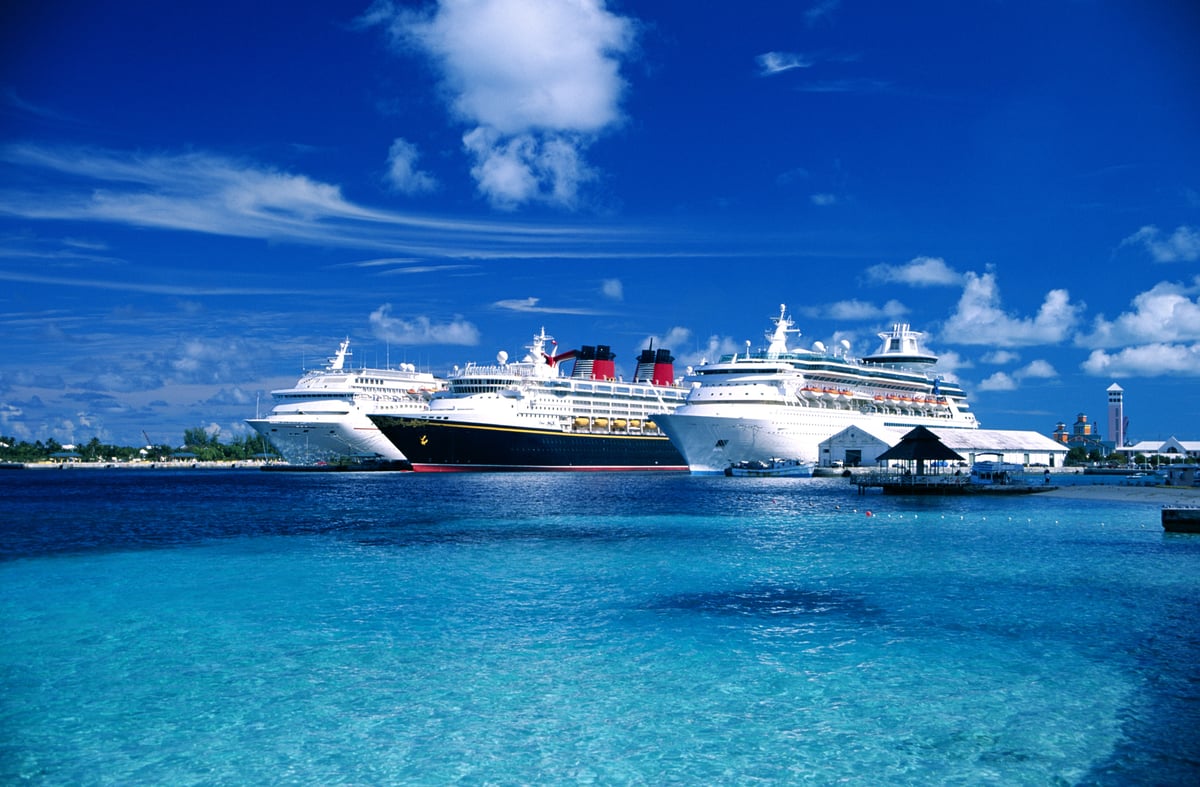
Royal Caribbean is the world's second-largest cruise company by revenues, operating 69 ships across five global and partner brands in the cruise vacation industry. Brands the company operates include Royal Caribbean International, Celebrity Cruises, and Silversea. The company also has a 50% investment in a joint venture that operates TUI Cruises and Hapag-Lloyd Cruises. The selection of brands in the portfolio allows Royal to compete on the basis of innovation, quality of ships and service, variety of itineraries, choice of destinations, and price. The company completed the divestiture of its Azamara brand in 2021, plans to launch its new Celebrity River Cruise brand in 2027, and is set to operate eight private destination locations by 2028 (up from three currently).
The chart shows the growth of an initial investment of $10,000 in Royal Caribbean Group, comparing it to the performance of the S&P 500 index. All prices have been adjusted for splits and dividends.
Returns By Period
Royal Caribbean Group (RCL) has returned -1.76% so far this year and 64.12% over the past 12 months. Looking at the last ten years, RCL has achieved an annualized return of 12.79%, outperforming the Benchmark (SPY), which averaged 12.23% per year.
RCL
1M-4.08%
6M-12.96%
YTD-1.76%
1Y64.12%
5Y25.17%
10Y12.79%
Benchmark (SPY)
1M-3.85%
6M-2.35%
YTD-4.36%
1Y34.06%
5Y9.80%
10Y12.23%
Monthly Returns
The table below presents the monthly returns of Royal Caribbean Group (RCL) with color gradation from worst to best to easily spot seasonal factors.
Jan
Feb
Mar
Apr
May
Jun
Jul
Aug
Sep
Oct
Nov
Dec
2026
16.57%
-4.90%
-5.74%
-3.27%
2025
15.14%
-4.49%
-16.71%
5.08%
17.32%
22.92%
2.54%
17.37%
-8.98%
-10.54%
-6.80%
6.26%
2024
0.19%
-5.30%
12.79%
-0.34%
6.63%
7.54%
-1.90%
4.32%
9.22%
16.21%
18.24%
-6.55%
2023
28.49%
8.68%
-7.82%
1.84%
23.58%
28.23%
5.42%
-7.58%
-7.13%
-7.65%
26.80%
20.48%
2022
0.31%
3.57%
5.42%
-7.84%
-25.33%
-39.90%
11.01%
11.10%
-5.49%
38.90%
9.16%
-18.15%
2021
-13.10%
41.43%
-7.73%
0.52%
6.64%
-10.18%
-10.51%
7.48%
6.60%
-8.53%
-17.30%
8.29%
2020
-12.98%
-30.90%
-60.53%
54.36%
20.26%
-3.27%
-6.31%
44.68%
-3.37%
-13.40%
43.29%
-6.64%
2019
24.53%
-1.71%
-4.46%
4.45%
-4.32%
0.01%
-4.64%
-10.12%
5.17%
0.57%
9.24%
11.11%
2018
11.13%
-5.06%
-6.81%
-8.31%
-3.12%
-1.26%
9.42%
8.39%
6.30%
-19.64%
7.68%
-14.40%
2017
13.19%
2.30%
1.28%
8.42%
3.16%
-1.25%
3.06%
5.49%
-5.10%
4.55%
-0.30%
-3.69%
2016
-5.32%
-0.95%
-12.93%
7.37%
-1.69%
4.45%
3.20%
5.01%
1.84%
Performance Indicators
The charts below present risk-adjusted performance metrics for Royal Caribbean Group (RCL) and compare them to a Benchmark (SPY). These indicators evaluate an investment's returns against its associated risks.
Sharpe ratio
Sortino ratio
Omega ratio
Calmar ratio
Martin ratio
sharpe ratio
The Sharpe ratio helps investors understand how much return they're getting for the level of risk taken. A higher Sharpe ratio indicates better risk-adjusted performance, meaning more reward for each unit of risk.
These values reflect how efficiently the investment has delivered returns relative to its volatility over different time periods. All figures are annualized and based on daily total returns.
The chart below shows the rolling Sharpe ratio of RCL compared to the benchmark. This view highlights how the investment's risk-adjusted performance has changed over time.
Volatility Chart
The current Royal Caribbean Group volatility is 3.24%, representing the standart deviation of percentage change in the investments's value, either up or down over the past month. The chart below shows the rolling one-month volatility.
Drawdowns Chart
The Drawdowns chart displays portfolio losses from any high point along the way. It shows the maximum percentage drop from a peak to a trough over a specified period, indicating the risk of significant losses. Although chart shows positive values, it represents the percentage drop from the peak, so a value of 10% means the portfolio has dropped 10% from its highest point.
Income Statement
The income statement provides a summary of a company's revenues, expenses, and profits over a specific period. It shows how much money the company earned (revenues) and how much it spent (expenses), leading to the net income or profit. This statement is crucial for understanding a company's financial performance and profitability.
2025
2023
2022
2021
2020
2019
2018
2017
2016
2015
2014
2013
2012
2011
2010
Liabilities And Equity (USD)
41.62B
35.13B
33.78B
32.26B
32.47B
30.32B
27.70B
22.30B
22.31B
20.92B
20.71B
20.07B
19.83B
19.80B
19.69B
Temporary Equity (USD)
-
-
-
-
-
569.98M
542.02M
-
-
-
-
-
-
-
-
Equity Attributable To Parent (USD)
10.04B
4.72B
2.87B
5.09B
8.76B
12.16B
11.11B
10.70B
9.12B
8.06B
8.28B
8.81B
8.31B
8.41B
7.94B
Equity Attributable To Noncontrolling Interest (USD)
Royal Caribbean demonstrates superior profitability with a 24% profit margin compared to Carnival's 11%, supported by premium positioning and stronger pricing power. Despite Carnival's cheaper valuation at 10x forward earnings versus Royal Caribbean's 14x, analysts expect Royal Caribbean to deliver higher earnings growth (17% vs 12% annualized), making it the better long-term investment despite its higher stock price.
The Motley Fool•John Ballard
AI Insight
Higher profit margins (24%), stronger pricing power from premium positioning, consistent earnings growth (33% YoY), management guidance for 20% annualized earnings growth through 2027, and superior long-term shareholder returns (309% over 3 years) make it the more attractive investment despite higher valuation.
Norwegian Cruise Line's stock plummeted 24% in March following disappointing Q4 earnings that missed revenue estimates and weak 2026 guidance. The company reported flat net yields despite rising costs, and geopolitical tensions driving higher oil prices further pressured the stock. Activist investor Elliott Management successfully pushed for board changes, though this failed to lift the stock.
The Motley Fool•Jeremy Bowman
AI Insight
Mentioned as a peer that has outperformed Norwegian post-pandemic recovery, but no specific company-related news or analysis provided in the article.
Norwegian Cruise Line (NCLH) has underperformed its rivals Carnival and Royal Caribbean in 2026, declining 16% through March. However, the analyst predicts the stock will recover in the remaining nine months of 2026 and suggests NCL should initiate a dividend to compete with its peers, which now yield over 2%. Despite being the cheapest of the three major cruise lines by valuation multiples, NCL trades at the lowest multiples but has historically lagged behind competitors.
The Motley Fool•Rick Munarriz
AI Insight
Royal Caribbean is the strongest performer among the three, generating record revenue and profitability. It reinstated dividends first and is the only cruise line posting record profitability, demonstrating superior operational performance.
Royal Caribbean is experiencing strong business momentum with record Q4 results and 35% YoY EPS growth, despite declining U.S. consumer confidence. The company's premium cruise niche and expansion into luxury land-based experiences position it well for future growth. However, rising oil prices from Middle East conflicts pose a near-term risk, though the company's fuel hedging strategy (60% of 2025 exposure) provides protection. While unlikely to make investors millionaires quickly, Royal Caribbean is well-positioned to beat the market.
President Trump claims progress in U.S.-Iran ceasefire talks, prompting Wall Street to price in de-escalation and drive risk assets higher. However, Iran denies negotiations exist and has set five non-negotiable preconditions fundamentally incompatible with U.S. demands. Ground reality shows no signs of de-escalation, with oil flows at 5% of normal levels and continued military exchanges. Prediction markets assign only 15-37% odds of ceasefire by mid-April, suggesting traders are skeptical despite optimistic headlines.
Benzinga•Piero Cingari
AI Insight
Cruise stock gaining over 3% alongside broader discretionary sector rally driven by perceived de-escalation in Middle East tensions.
Cruise line stocks have plummeted in March due to rising oil prices from Middle East conflicts and concerns about passenger demand, but they now trade at low valuations. While near-term headwinds are real, long-term fundamentals remain strong. Royal Caribbean and Viking offer better value than Norwegian Cruise Line, while Carnival presents potential value despite economic downturn vulnerability.
The Motley Fool•Rick Munarriz
AI Insight
Consistently delivers healthier margins and growth, first to return to profitability post-pandemic and reinstate dividends, commands market premium justifiably, and has beaten the market over the past year.
U.S. equities staged a broad relief-driven rebound after President Trump announced a five-day pause in military strikes on Iranian energy infrastructure. Oil prices crashed nearly 8%, with WTI crude falling to around $90.39 per barrel. The S&P 500 rose 1.37%, the Dow gained 1.72%, and the Russell 2000 small-cap index outperformed with a 2.58% gain. Consumer discretionary and travel stocks led gains, while energy stocks lagged.
Benzinga•Piero Cingari
AI Insight
Travel and leisure stock gained 4.5% as lower oil prices and reduced tensions improved the cruise industry's profitability outlook.
Markets rallied sharply on Monday following President Trump's announcement of a five-day halt to U.S. military strikes on Iranian energy infrastructure and claims of productive peace talks, despite Iran's swift denial of any negotiations. The S&P 500 gained 1.64%, with stocks hardest hit by the Middle East conflict—particularly cruise operators, airlines, and homebuilders—experiencing the strongest rebounds. Gold miners and construction-related ETFs also performed well amid the relief rally.
Benzinga•Piero Cingari
AI Insight
Cruise operator gained 7.37% on Monday as part of the relief rally for war-impacted stocks following Trump's peace talk announcement.
President Trump announced a 5-day pause on U.S. strikes against Iranian energy infrastructure following 'productive conversations' with Tehran, causing oil prices to plunge 8% and stock futures to surge. West Texas Intermediate crude fell to $90.10/barrel while Brent dropped to $103.31. Travel and airline stocks rallied sharply as fuel-sensitive sectors benefited from lower oil prices. The move raises questions about whether the 'TACO trade' (Trump Always Chickens Out) pattern is repeating.
Benzinga•Piero Cingari
AI Insight
Cruise line operator benefits from lower fuel costs. Stock rallied 4.6% in premarket trading.
Three weeks into the Iran war, markets are repositioning for a prolonged conflict lasting months rather than days. A 32-percentage-point divergence has emerged between stocks benefiting from a closed Strait of Hormuz (energy, defense, drones) which are up 17.55% on average, and those needing it open (airlines, cruise lines, logistics) which are down 15.35% on average. Prediction markets assign only a 26% probability of normal traffic returning by April 30, suggesting at least six more weeks of disruption.
Benzinga•Piero Cingari
AI Insight
Down 9.22% as cruise operations face disruption and fuel cost pressures