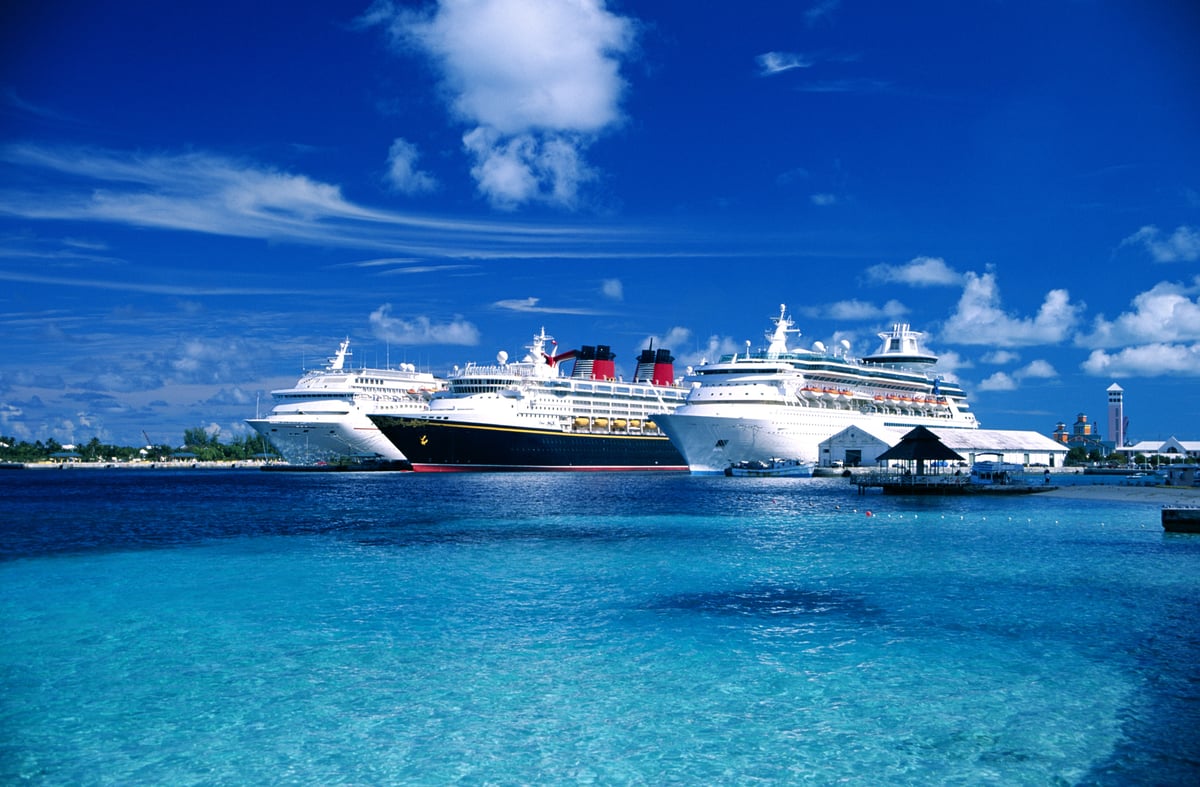
Carnival is the largest global cruise company, with nearly 100 ships in service. Its portfolio of brands includes Carnival Cruise Lines, Holland America, Princess Cruises, and Seabourn in North America; P&O Cruises and Cunard Line in the United Kingdom; Aida in Germany; Costa Cruises in Southern Europe. It recently folded its P&O Australia brand into Carnival. The firm also owns Holland America Princess Alaska Tours in Alaska and the Canadian Yukon. Carnival's brands attracted nearly 14 million guests in 2025.
The chart shows the growth of an initial investment of $10,000 in Carnival Corporation, comparing it to the performance of the S&P 500 index. All prices have been adjusted for splits and dividends.
Returns By Period
Carnival Corporation (CCL) has returned -16.45% so far this year and 67.25% over the past 12 months. Looking at the last ten years, CCL has achieved an annualized return of -6.97%, underperforming the Benchmark (SPY), which averaged 12.23% per year.
CCL
1M-7.47%
6M-10.54%
YTD-16.45%
1Y67.25%
5Y-2.37%
10Y-6.97%
Benchmark (SPY)
1M-3.85%
6M-2.35%
YTD-4.36%
1Y34.06%
5Y9.80%
10Y12.23%
Monthly Returns
The table below presents the monthly returns of Carnival Corporation (CCL) with color gradation from worst to best to easily spot seasonal factors.
Jan
Feb
Mar
Apr
May
Jun
Jul
Aug
Sep
Oct
Nov
Dec
2026
-2.18%
4.56%
-10.29%
-3.21%
2025
10.11%
-9.77%
-18.01%
-6.43%
24.30%
21.89%
6.04%
9.81%
-5.83%
-0.17%
-10.52%
19.11%
2024
-9.45%
-7.20%
2.77%
-10.07%
3.08%
23.08%
-10.67%
-1.73%
13.37%
17.65%
15.59%
-2.92%
2023
31.31%
-1.85%
-4.43%
-7.72%
21.14%
66.34%
1.56%
-12.89%
-13.33%
-15.11%
31.53%
22.62%
2022
-3.65%
1.93%
1.25%
-14.99%
-19.82%
-38.39%
5.23%
6.29%
-24.33%
26.36%
5.75%
-19.08%
2021
-13.96%
41.09%
-3.67%
3.59%
5.50%
-12.69%
-18.56%
10.58%
3.26%
-15.00%
-20.99%
11.04%
2020
-15.23%
-23.52%
-59.74%
26.19%
5.64%
2.75%
-18.06%
22.26%
-5.66%
-11.15%
48.11%
3.19%
2019
17.65%
0.36%
-13.06%
7.57%
-7.93%
-8.71%
1.01%
-6.39%
-0.25%
-2.08%
4.28%
12.56%
2018
6.53%
-6.98%
-1.55%
-3.99%
-1.52%
-8.57%
4.24%
3.94%
4.18%
-12.05%
6.92%
-18.65%
2017
6.03%
1.23%
4.25%
4.69%
3.71%
1.96%
1.72%
1.92%
-7.52%
3.64%
-1.41%
1.61%
2016
-6.03%
-3.22%
-6.51%
4.47%
2.62%
1.60%
0.74%
4.73%
2.38%
Performance Indicators
The charts below present risk-adjusted performance metrics for Carnival Corporation (CCL) and compare them to a Benchmark (SPY). These indicators evaluate an investment's returns against its associated risks.
Sharpe ratio
Sortino ratio
Omega ratio
Calmar ratio
Martin ratio
sharpe ratio
The Sharpe ratio helps investors understand how much return they're getting for the level of risk taken. A higher Sharpe ratio indicates better risk-adjusted performance, meaning more reward for each unit of risk.
These values reflect how efficiently the investment has delivered returns relative to its volatility over different time periods. All figures are annualized and based on daily total returns.
The chart below shows the rolling Sharpe ratio of CCL compared to the benchmark. This view highlights how the investment's risk-adjusted performance has changed over time.
Volatility Chart
The current Carnival Corporation volatility is 3.69%, representing the standart deviation of percentage change in the investments's value, either up or down over the past month. The chart below shows the rolling one-month volatility.
Drawdowns Chart
The Drawdowns chart displays portfolio losses from any high point along the way. It shows the maximum percentage drop from a peak to a trough over a specified period, indicating the risk of significant losses. Although chart shows positive values, it represents the percentage drop from the peak, so a value of 10% means the portfolio has dropped 10% from its highest point.
Income Statement
The income statement provides a summary of a company's revenues, expenses, and profits over a specific period. It shows how much money the company earned (revenues) and how much it spent (expenses), leading to the net income or profit. This statement is crucial for understanding a company's financial performance and profitability.
2025
2024
2023
2022
2021
2020
2019
2018
2017
2016
2015
2014
2013
2012
2011
2009
Liabilities And Equity (USD)
51.69B
49.06B
49.12B
51.70B
53.34B
53.59B
45.06B
42.40B
40.78B
38.94B
39.24B
39.53B
40.10B
39.16B
38.64B
36.84B
Equity Attributable To Parent (USD)
12.28B
9.25B
6.88B
7.07B
12.14B
20.56B
25.37B
24.44B
24.22B
22.60B
23.77B
24.29B
24.56B
23.93B
23.83B
22.04B
Equity Attributable To Noncontrolling Interest (USD)
Royal Caribbean demonstrates superior profitability with a 24% profit margin compared to Carnival's 11%, supported by premium positioning and stronger pricing power. Despite Carnival's cheaper valuation at 10x forward earnings versus Royal Caribbean's 14x, analysts expect Royal Caribbean to deliver higher earnings growth (17% vs 12% annualized), making it the better long-term investment despite its higher stock price.
The Motley Fool•John Ballard
AI Insight
While delivering record revenue and net income with a 50% cumulative earnings growth plan through 2029, Carnival's lower profit margin (11%), price-competitive strategy, and lower expected earnings growth (12% annualized) compared to Royal Caribbean suggest it is a weaker operator, though the cheaper valuation (10x P/E) provides some appeal.
Norwegian Cruise Line's stock plummeted 24% in March following disappointing Q4 earnings that missed revenue estimates and weak 2026 guidance. The company reported flat net yields despite rising costs, and geopolitical tensions driving higher oil prices further pressured the stock. Activist investor Elliott Management successfully pushed for board changes, though this failed to lift the stock.
The Motley Fool•Jeremy Bowman
AI Insight
Mentioned as a peer that has outperformed Norwegian post-pandemic recovery. Unlike Norwegian, Carnival does not hedge fuel costs, making it more vulnerable to oil price increases, but no specific negative news reported in this article.
President Trump escalated threats against Iran, announcing intensified bombing campaigns over the next 2-3 weeks and threatening to destroy Iranian infrastructure. WTI crude surged 9% to $110/barrel, with the Strait of Hormuz remaining effectively closed. Airlines and cruise lines face significant margin pressure as jet fuel and diesel costs spike, with five travel stocks experiencing the steepest declines.
Benzinga•Piero Cingari
AI Insight
Heavy fuel oil is primary operating cost; rising fuel prices plus suppressed discretionary cruise bookings from higher gas prices; stock down 3.25%
Norwegian Cruise Line (NCLH) has underperformed its rivals Carnival and Royal Caribbean in 2026, declining 16% through March. However, the analyst predicts the stock will recover in the remaining nine months of 2026 and suggests NCL should initiate a dividend to compete with its peers, which now yield over 2%. Despite being the cheapest of the three major cruise lines by valuation multiples, NCL trades at the lowest multiples but has historically lagged behind competitors.
The Motley Fool•Rick Munarriz
AI Insight
Carnival has outperformed NCL over the past 12 months with 30%+ returns and recently reinstated dividends yielding over 2%. However, it is not generating record profitability like Royal Caribbean, indicating mixed performance.
Carnival Corp. stock fell nearly 6% after Q1 2026 earnings despite beating estimates and reporting record bookings. Elevated fuel costs from the Iran war pose a near-term headwind, with a 10% oil price increase potentially reducing earnings by 11 cents per share. However, the company's improving balance sheet, discounted valuation (11x current earnings), ambitious PROPEL strategic plan through 2029, and $14 billion shareholder return commitment support a bullish long-term outlook. Technical indicators warn of a potential death cross, suggesting caution in the short term.
Investing.com•Chris Markoch
AI Insight
Despite near-term fuel cost headwinds, Carnival demonstrates strong fundamentals: beat Q1 earnings expectations, record bookings (85% of 2026 already booked), improving balance sheet with interest expenses down 23% year-over-year, discounted valuation at 11x current earnings, and ambitious PROPEL plan committing $14 billion to shareholder returns through 2029. Analysts maintain Moderate Buy consensus with ~20% upside potential. Long-term outlook is bullish if fuel costs moderate.
Major U.S. stock indexes fell on March 27, 2026, as crude oil surged above $110 per barrel amid geopolitical tensions, driving a broad sell-off. Energy stocks gained while tech mega-caps declined due to AI spending concerns and lawsuit pressures. The Nasdaq entered correction territory, falling over 10% from its October high.
The Motley Fool•Emma Newbery
AI Insight
Dropped 4.31% after cutting 2026 outlook and facing geopolitical headwinds
Royal Caribbean is experiencing strong business momentum with record Q4 results and 35% YoY EPS growth, despite declining U.S. consumer confidence. The company's premium cruise niche and expansion into luxury land-based experiences position it well for future growth. However, rising oil prices from Middle East conflicts pose a near-term risk, though the company's fuel hedging strategy (60% of 2025 exposure) provides protection. While unlikely to make investors millionaires quickly, Royal Caribbean is well-positioned to beat the market.
The Motley Fool•Will Ebiefung
AI Insight
Stock down 17% year-to-date, underperforming Royal Caribbean despite similar industry challenges. Less effective at managing fuel cost pressures and lacks the premium positioning and diversification strategy of Royal Caribbean.
President Trump claims progress in U.S.-Iran ceasefire talks, prompting Wall Street to price in de-escalation and drive risk assets higher. However, Iran denies negotiations exist and has set five non-negotiable preconditions fundamentally incompatible with U.S. demands. Ground reality shows no signs of de-escalation, with oil flows at 5% of normal levels and continued military exchanges. Prediction markets assign only 15-37% odds of ceasefire by mid-April, suggesting traders are skeptical despite optimistic headlines.
Benzinga•Piero Cingari
AI Insight
Cruise stock rebounding sharply (+3%) on market optimism about Middle East de-escalation and reduced geopolitical risk premium. War-battered discretionary stocks leading the rebound.
President Trump has sent Iran a 15-point peace plan addressing nuclear programs and maritime routes, with prediction markets showing a 48% probability of a U.S.-Iran ceasefire by April 30. Ten Russell 1000 stocks down 17-33% since the war began are positioned for potential recovery if peace talks succeed. War-battered sectors including airlines, mining, and cruise lines staged sharp premarket rebounds on the diplomatic developments.
Benzinga•Piero Cingari
AI Insight
Down 19.27% from sustained demand shock in cruise sector; peace resolution would alleviate consumer uncertainty and restore travel demand.
Cruise line stocks have plummeted in March due to rising oil prices from Middle East conflicts and concerns about passenger demand, but they now trade at low valuations. While near-term headwinds are real, long-term fundamentals remain strong. Royal Caribbean and Viking offer better value than Norwegian Cruise Line, while Carnival presents potential value despite economic downturn vulnerability.
The Motley Fool•Rick Munarriz
AI Insight
Largest by revenue but most vulnerable to economic downturns; currently offers potential value at low multiples, recently reinstated dividend, but faces cost pressures and demand uncertainty.