


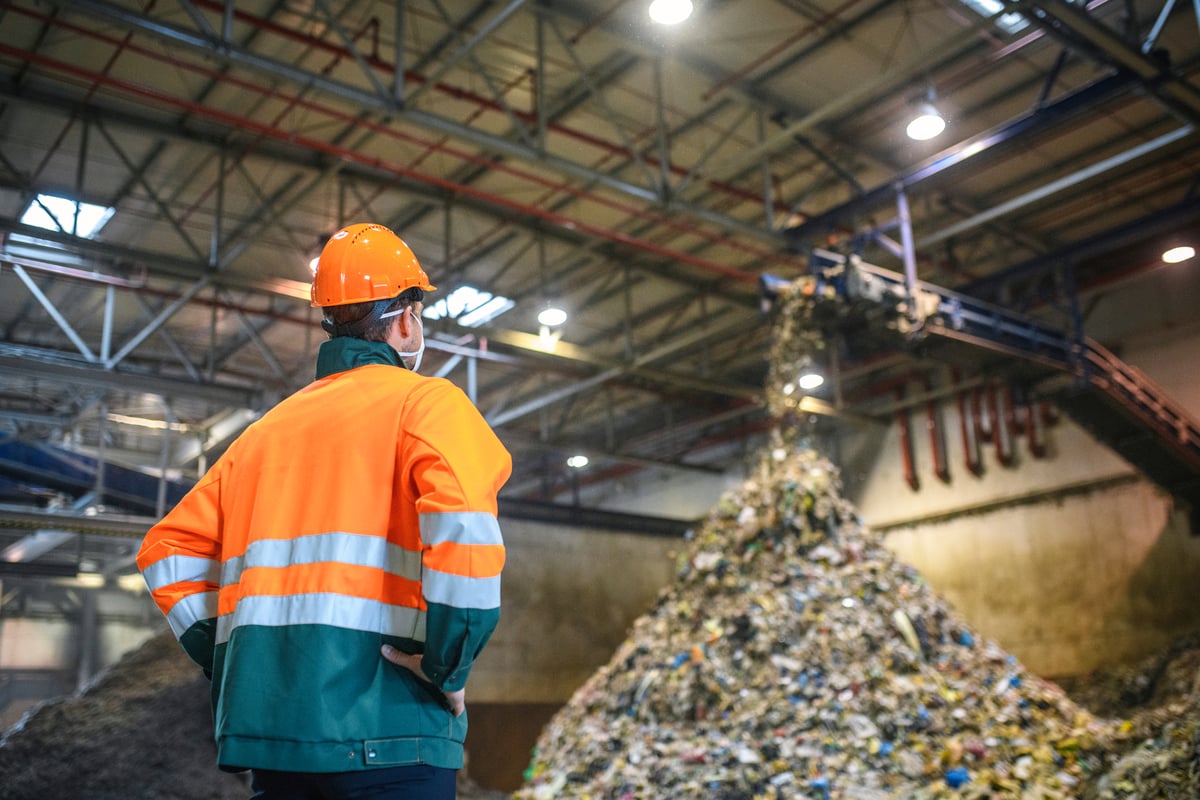
Waste Management is the largest trash hauler in North America with significant industry advantages, including limited landfill supply, high barriers to entry, and a consistent 22-year history of dividend increases.

Waste Connections is a North American waste management company focused on integrated waste collection services. The firm primarily focuses on residential, commercial, municipal, and industrial waste collection, with a secondary market focus on rural areas. With 113 landfills and 222 transfer stations as of 2024, it is the third-largest waste management company by revenue. Revenue is split among six operating segments: Western, Southern, Eastern, Central, Canada, and Midsouth.
The chart shows the growth of an initial investment of $10,000 in Waste Connections, Inc., comparing it to the performance of the S&P 500 index.
All prices have been adjusted for splits and dividends.
Waste Connections, Inc. (WCN) has returned -5.03% so far this year and -9.08% over the past 12 months. Looking at the last ten years, WCN has achieved an annualized return of 14.43%, outperforming the Benchmark (SPY), which averaged 12.23% per year.
The table below presents the monthly returns of Waste Connections, Inc. (WCN) with color gradation from worst to best to easily spot seasonal factors.
| Jan | Feb | Mar | Apr | May | Jun | Jul | Aug | Sep | Oct | Nov | Dec | |
|---|---|---|---|---|---|---|---|---|---|---|---|---|
| 2026 | -4.16% | 1.87% | -5.14% | 2.00% | ||||||||
| 2025 | 6.63% | 4.72% | 2.31% | 1.93% | 0.21% | -4.68% | -0.37% | -1.80% | -4.52% | -4.48% | 5.52% | -0.65% |
| 2024 | 5.03% | 6.51% | 3.81% | -5.59% | 1.40% | 6.72% | 1.04% | 4.82% | -3.98% | -0.67% | 8.26% | -10.86% |
| 2023 | 0.29% | 1.62% | 4.35% | 0.03% | -2.15% | 4.94% | -0.56% | -3.07% | -2.74% | -3.29% | 4.51% | 10.15% |
| 2022 | -8.40% | -0.80% | 12.95% | -1.15% | -7.01% | -3.13% | 7.79% | 4.84% | -1.61% | -3.17% | 8.69% | -8.57% |
| 2021 | -4.01% | -0.98% | 9.68% | 9.99% | 1.20% | -2.09% | 6.24% | 1.98% | -3.26% | 7.59% | -2.18% | 1.40% |
| 2020 | 6.02% | -0.09% | -19.76% | 14.29% | 10.73% | -0.17% | 8.86% | -2.25% | 3.84% | -4.44% | 4.15% | -1.51% |
| 2019 | 13.52% | -0.25% | 5.56% | 4.35% | 1.71% | 1.54% | -5.58% | 1.04% | 0.56% | 0.33% | -2.61% | 0.54% |
| 2018 | 1.58% | -1.06% | 1.10% | 0.84% | 6.45% | -2.54% | 3.27% | 1.76% | 1.32% | -4.78% | 2.97% | -6.13% |
| 2017 | 2.38% | 8.97% | 0.80% | 4.28% | 2.88% | 1.16% | 0.92% | 2.54% | 4.48% | 0.84% | -3.07% | 2.66% |
| 2016 | 4.31% | -2.57% | 10.00% | 3.09% | 2.19% | -1.85% | 0.23% | 1.26% | 2.54% |
The charts below present risk-adjusted performance metrics for Waste Connections, Inc. (WCN) and compare them to a Benchmark (SPY). These indicators evaluate an investment's returns against its associated risks.
The Sharpe ratio helps investors understand how much return they're getting for the level of risk taken. A higher Sharpe ratio indicates better risk-adjusted performance, meaning more reward for each unit of risk.
These values reflect how efficiently the investment has delivered returns relative to its volatility over different time periods. All figures are annualized and based on daily total returns.
The chart below shows the rolling Sharpe ratio of WCN compared to the benchmark. This view highlights how the investment's risk-adjusted performance has changed over time.
The current Waste Connections, Inc. volatility is 1.51%, representing the standart deviation of percentage change in the investments's value, either up or down over the past month. The chart below shows the rolling one-month volatility.
The Drawdowns chart displays portfolio losses from any high point along the way. It shows the maximum percentage drop from a peak to a trough over a specified period, indicating the risk of significant losses.
Although chart shows positive values, it represents the percentage drop from the peak, so a value of 10% means the portfolio has dropped 10% from its highest point.
The income statement provides a summary of a company's revenues, expenses, and profits over a specific period. It shows how much money the company earned (revenues) and how much it spent (expenses), leading to the net income or profit. This statement is crucial for understanding a company's financial performance and profitability.
| 2025 | 2024 | 2023 | 2022 | 2021 | 2020 | 2019 | 2018 | 2017 | 2016 | |
|---|---|---|---|---|---|---|---|---|---|---|
| Liabilities And Equity (USD) | 21.13B | 19.82B | 17.92B | 17.13B | 14.70B | 13.99B | 13.74B | 12.63B | 12.01B | 11.19B |
| Equity Attributable To Parent (USD) | 8.25B | 7.86B | 7.69B | 7.11B | 6.99B | 6.86B | 6.93B | 6.45B | 6.27B | 5.65B |
| Equity Attributable To Noncontrolling Interest (USD) | - | - | 4.97M | 4.95M | 4.61M | 4.17M | 4.85M | 5.58M | 5.40M | 7.36M |
| Equity (USD) | 8.25B | 7.86B | 7.70B | 7.11B | 6.99B | 6.86B | 6.94B | 6.46B | 6.27B | 5.65B |
| Other Non-current Liabilities (USD) | - | - | - | - | - | 1.36B | 1.42B | 1.13B | 1.01B | 1.21B |
| Long-term Debt (USD) | - | - | - | - | - | 4.74B | 4.38B | 4.17B | 3.93B | 3.63B |
| Noncurrent Liabilities (USD) | 10.76B | 10.08B | 8.53B | 8.51B | 6.47B | 6.10B | 5.79B | 5.31B | 4.94B | 4.85B |
| Other Current Liabilities (USD) | 1.21B | 1.11B | 937.05M | 747.61M | 698.00M | 597.95M | 498.67M | 413.61M | 385.64M | 366.75M |
| Wages (USD) | 152.62M | 127.52M | 108.42M | 126.30M | 141.88M | 139.89M | 71.59M | 87.14M | 86.44M | 74.17M |
| Accounts Payable (USD) | 765.23M | 637.37M | 642.46M | 638.73M | 392.87M | 290.82M | 436.97M | 359.97M | 330.52M | 251.25M |
| Current Liabilities (USD) | 2.12B | 1.88B | 1.69B | 1.51B | 1.23B | 1.03B | 1.01B | 860.71M | 802.60M | 692.18M |
| Liabilities (USD) | 12.88B | 11.96B | 10.22B | 10.02B | 7.71B | 7.13B | 6.80B | 6.17B | 5.74B | 5.54B |
| Other Non-current Assets (USD) | 9.08B | 8.56B | 7.94B | 7.39B | 6.59B | 6.14B | 5.93B | 5.24B | 4.93B | 4.56B |
| Intangible Assets (USD) | 2.01B | 1.99B | 1.60B | 1.67B | 1.35B | 1.16B | 1.16B | 1.13B | 1.09B | 1.07B |
| Fixed Assets (USD) | 8.73B | 8.04B | 7.23B | 6.95B | 5.72B | 5.28B | 5.52B | 5.17B | 4.82B | 4.74B |
| Noncurrent Assets (USD) | 19.82B | 18.59B | 16.77B | 16.02B | 13.67B | 12.58B | 12.61B | 11.53B | 10.84B | 10.36B |
| Current Assets (USD) | 1.31B | 1.23B | 1.14B | 1.12B | 1.03B | 1.41B | 1.13B | 1.09B | 1.18B | 832.57M |
| Assets (USD) | 21.13B | 19.82B | 17.92B | 17.13B | 14.70B | 13.99B | 13.74B | 12.63B | 12.01B | 11.19B |
Waste Management is the largest trash hauler in North America with significant industry advantages, including limited landfill supply, high barriers to entry, and a consistent 22-year history of dividend increases.
Global waste recycling services market projected to grow from $65.08 billion in 2024 to $109.79 billion by 2033, driven by environmental concerns, regulations, and technological advancements in recycling.
The global waste management market is projected to grow from $1219.6 billion in 2024 to $1598.1 billion by 2029, with a 5.6% CAGR, driven by government measures, technological advancements, and increasing e-waste generation.

Waste Connections reported Q2 2025 financial results with revenue of $2.41 billion, beating estimates. The company maintained full-year guidance despite volume challenges, leveraging solid waste pricing and strategic acquisitions.

Waste Connections has declared a quarterly cash dividend of $0.315 per common share, payable on August 21, 2025, to shareholders of record as of August 6, 2025. The company intends to review the dividend each October with a long-term objective of increasing the amount.

Seaport Research initiated coverage on several major waste management companies, highlighting their resilient business models, dependable recurring revenue, and significant barriers to entry. The analyst believes these companies have historically outperformed the S&P 500 during market corrections.
Waste Connections announced a regular quarterly cash dividend of $0.315 U.S. per common share, to be paid on May 22, 2025 to shareholders of record on May 7, 2025.
The global bioremediation market is expected to grow significantly from $16.36 billion in 2023 to $49.36 billion by 2034, driven by factors like rising environmental regulations, technological advancements, and increased government initiatives. The report covers market analysis by type, technology, service, end-user, and region, along with profiles of the top 10+ major players.
The Construction and Demolition Waste Management Market is growing rapidly due to increasing urbanization, regulatory shifts, and advancements in recycling technologies, with a strong focus on sustainable solutions to address rising waste and environmental challenges.
The global waste management market is expected to grow from $1.42 trillion in 2023 to $2.5 trillion by 2033, driven by the rising generation of waste in urban centers. Key activities include garbage collection, sorting, composting, recycling, and disposal methods.