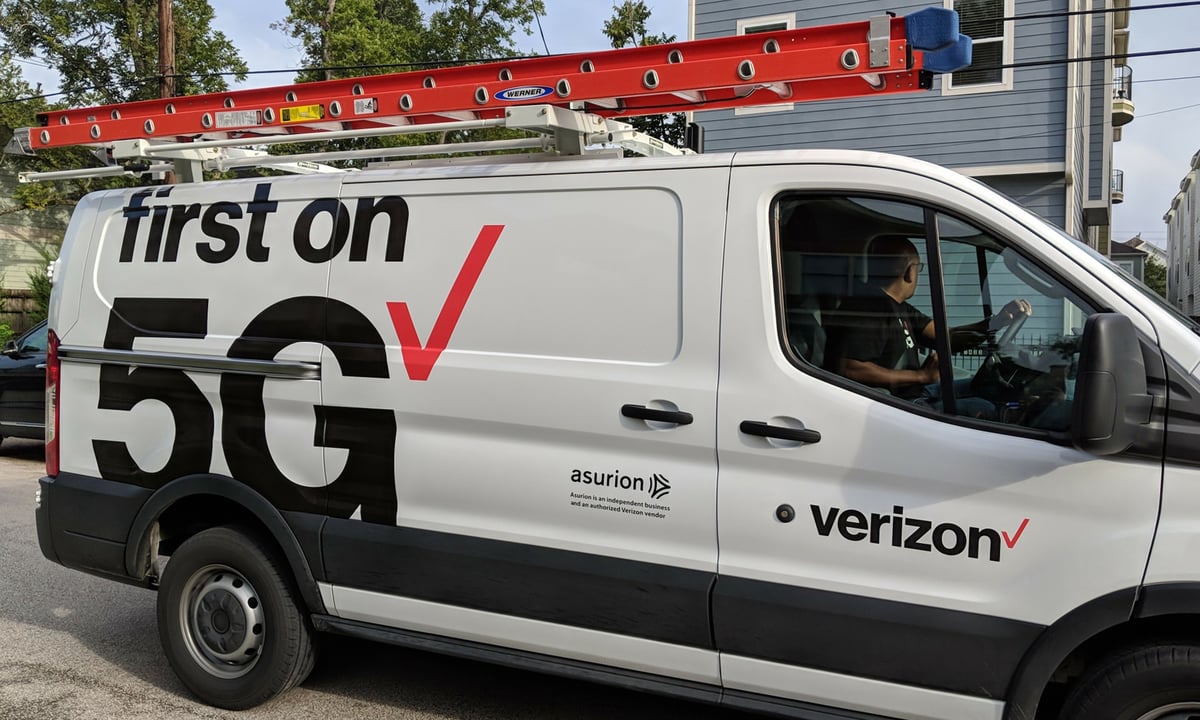
Wireless services account for 75% of Verizon Communications' total service revenue and nearly all of its operating income. The firm serves about 94 million postpaid and 20 million prepaid phone customers via its nationwide network, making it the largest US wireless carrier. Fixed-line telecom operations include local networks in the Northeast that reach about 30 million homes and businesses, including about 20 million served by the Fios fiber-optic network. Verizon closed its acquisition of Frontier Communications in January, adding networks that reach another 15 million locations, including 9 million with fiber. These networks serve about 11 million broadband customers. Verizon also provides telecom services nationwide to enterprise customers, using a mix of its own and other networks.
Company Info
SIC4813
Composite FIGIBBG000HS77T5
CIK0000732712
IPONov 21, 1983
Sectortelephone communications (no radiotelephone)
The chart shows the growth of an initial investment of $10,000 in Verizon Communications, comparing it to the performance of the S&P 500 index. All prices have been adjusted for splits and dividends.
Returns By Period
Verizon Communications (VZ) has returned 21.17% so far this year and 18.95% over the past 12 months. Looking at the last ten years, VZ has achieved an annualized return of -0.89%, underperforming the Benchmark (SPY), which averaged 12.23% per year.
VZ
1M-3.08%
6M14.22%
YTD21.17%
1Y18.95%
5Y-3.04%
10Y-0.89%
Benchmark (SPY)
1M-3.85%
6M-2.35%
YTD-4.36%
1Y34.06%
5Y9.80%
10Y12.23%
Monthly Returns
The table below presents the monthly returns of Verizon Communications (VZ) with color gradation from worst to best to easily spot seasonal factors.
Jan
Feb
Mar
Apr
May
Jun
Jul
Aug
Sep
Oct
Nov
Dec
2026
9.20%
12.48%
0.44%
-1.34%
2025
-1.60%
9.64%
5.59%
-3.14%
0.43%
-1.21%
-1.52%
2.17%
-0.48%
-9.51%
4.05%
-0.56%
2024
12.24%
-6.23%
4.93%
-5.95%
4.63%
0.15%
-2.17%
2.74%
7.03%
-6.29%
5.27%
-9.67%
2023
4.53%
-7.57%
0.46%
-0.56%
-9.04%
4.47%
-8.31%
2.01%
-7.37%
8.29%
8.26%
-1.82%
2022
2.23%
0.51%
-4.79%
-9.25%
10.28%
-1.34%
-9.36%
-9.68%
-8.81%
-2.94%
2.63%
0.56%
2021
-7.14%
0.05%
4.79%
-0.40%
-2.99%
-1.27%
-0.71%
-1.89%
-1.80%
-1.91%
-5.58%
2.89%
2020
-3.16%
-9.14%
-2.59%
9.43%
-0.66%
-2.77%
4.34%
2.42%
0.63%
-4.06%
4.75%
-2.78%
2019
-1.96%
3.10%
3.70%
-3.70%
-5.03%
4.48%
-3.74%
1.84%
4.25%
0.12%
-1.71%
1.99%
2018
1.71%
-12.39%
0.27%
3.63%
-3.68%
5.05%
2.77%
4.52%
-0.30%
6.49%
5.83%
-5.51%
2017
-9.17%
0.59%
-1.63%
-5.79%
1.26%
-4.39%
8.50%
-1.46%
3.06%
-3.08%
5.69%
3.99%
2016
-4.46%
-0.62%
9.77%
-0.79%
-5.85%
-0.31%
-7.21%
3.27%
7.19%
Performance Indicators
The charts below present risk-adjusted performance metrics for Verizon Communications (VZ) and compare them to a Benchmark (SPY). These indicators evaluate an investment's returns against its associated risks.
Sharpe ratio
Sortino ratio
Omega ratio
Calmar ratio
Martin ratio
sharpe ratio
The Sharpe ratio helps investors understand how much return they're getting for the level of risk taken. A higher Sharpe ratio indicates better risk-adjusted performance, meaning more reward for each unit of risk.
These values reflect how efficiently the investment has delivered returns relative to its volatility over different time periods. All figures are annualized and based on daily total returns.
The chart below shows the rolling Sharpe ratio of VZ compared to the benchmark. This view highlights how the investment's risk-adjusted performance has changed over time.
Volatility Chart
The current Verizon Communications volatility is 0.88%, representing the standart deviation of percentage change in the investments's value, either up or down over the past month. The chart below shows the rolling one-month volatility.
Drawdowns Chart
The Drawdowns chart displays portfolio losses from any high point along the way. It shows the maximum percentage drop from a peak to a trough over a specified period, indicating the risk of significant losses. Although chart shows positive values, it represents the percentage drop from the peak, so a value of 10% means the portfolio has dropped 10% from its highest point.
Income Statement
The income statement provides a summary of a company's revenues, expenses, and profits over a specific period. It shows how much money the company earned (revenues) and how much it spent (expenses), leading to the net income or profit. This statement is crucial for understanding a company's financial performance and profitability.
2025
2023
2022
2021
2020
2019
2018
2017
2016
2015
2014
2013
2012
2011
2010
2009
Liabilities And Equity (USD)
404.26B
380.26B
379.68B
366.60B
316.48B
291.73B
264.83B
257.14B
244.18B
244.64B
232.71B
274.10B
225.22B
230.46B
220.01B
227.25B
Equity Attributable To Parent (USD)
104.46B
92.43B
91.14B
81.79B
67.84B
61.40B
53.15B
43.10B
22.52B
16.43B
12.30B
38.84B
33.16B
35.97B
38.57B
41.61B
Equity Attributable To Noncontrolling Interest (USD)
Q1 2026 saw the highest percentage of dividend increase announcements since 2019 at 45%, reflecting boardroom optimism despite macroeconomic uncertainty. However, a significant divide emerged: mega-cap companies (60%+ increase rate) aggressively hiked payouts, while small-cap firms remained cautious with only 38% increases. Regional divergence also appeared, with Asia-Pacific and Oceania experiencing broader dividend cuts.
Investing.com•Christine Short
AI Insight
Identified as an industry titan with notable dividend increases, reflecting strong financial position and commitment to shareholder returns.
The article examines the three highest-yielding stocks in the Dow Jones—Verizon (5.6% yield), Chevron (3.3% yield), and UnitedHealth Group (3.3% yield)—concluding that none represent a clear buying opportunity. Verizon offers reliable income but faces high debt and slow dividend growth; Chevron is well-managed but may be overpriced due to temporary oil price spikes; UnitedHealth is an industry leader but faces regulatory headwinds and earnings volatility.
The Motley Fool•Reuben Gregg Brewer
AI Insight
Offers attractive 5.6% yield with reliable subscription-based business model, but high debt levels and dividend growth below inflation rate limit long-term appeal. Suitable only for income maximization, not long-term growth.
Verizon Communications has surged 24% year-to-date through March 2026, driven by strong Q4 2025 earnings with record postpaid phone net additions and the completion of its Frontier Communications acquisition, expanding fiber access to over 30 million homes. With a 5.6% dividend yield and 22 consecutive years of dividend increases, the stock appeals to income-focused investors, though analysts caution against expecting continued outperformance as wireless carriers typically deliver modest long-term returns.
The Motley Fool•Lyle Daly
AI Insight
Strong 24% year-to-date performance, record Q4 2025 earnings with highest quarterly net additions since 2019, successful Frontier Communications acquisition expanding fiber infrastructure, consistent dividend growth (22 consecutive years), and attractive 5.6% dividend yield make it a compelling investment for income-focused investors seeking stability.
Verizon Communications Inc. announced it will report first-quarter 2026 earnings on Monday, April 27, 2026, with a webcast presentation beginning at 8:30 a.m. ET. Materials including the press release and financial tables will be available at 7:00 a.m. ET on Verizon's Investor Relations website.
GlobeNewswire Inc.•
AI Insight
The article is a factual announcement of an upcoming earnings report date and webcast. It contains no forward-looking statements, performance metrics, or qualitative assessments that would indicate positive or negative sentiment. It is purely informational regarding the timing and logistics of the earnings presentation.
AST SpaceMobile stock has pulled back 37% from its 52-week high of $129.30 to around $81, primarily due to a $3.9 billion capital restructuring in February that increased share count and raised concerns about mounting satellite launch costs. While the company achieved significant revenue growth to $70.9 million in 2025 and secured a $30 million military contract, it remains deeply unprofitable with a $340 million net loss and $2.2 billion in long-term debt. The stock trades at a lofty price-to-sales ratio of 288.6, pricing in speculative future earnings, while facing competition from SpaceX's Starlink and other direct-to-device satellite providers.
The Motley Fool•James Halley
AI Insight
Strategic partnership with AST SpaceMobile, but also a potential competitor as ground-based network coverage expands.
As market volatility rises and the VIX approaches multi-month peaks, investors should consider defensive stocks rather than exiting the market entirely. Three recommended defensive plays are Verizon Communications for its 5.7% dividend yield and essential mobile service demand, Coca-Cola for its affordable consumer staples and 64-year dividend growth streak, and Waste Management for its recession-resistant garbage disposal services that historically outperform during market downturns.
The Motley Fool•James Brumley
AI Insight
Recommended as a defensive pick with a strong 5.7% forward dividend yield. Essential service with persistent demand due to high consumer dependence on mobile phones, making it resilient during economic downturns.
With stock market declines creating higher dividend yields, five high-quality dividend stocks currently offer yields above 5% for passive income investors. EPR Properties (7.1%), Enbridge (5.3%), Realty Income (5.3%), T. Rowe Price (6%), and Verizon (5.7%) are highlighted as strong candidates with conservative payout ratios, solid balance sheets, and consistent dividend growth histories.
The Motley Fool•Matt Dilallo
AI Insight
5.7% yield with 19 consecutive years of dividend increases, generates $20.1B+ in free cash flow easily covering $11.5B dividends, $20B Frontier acquisition, and continued 5G/fiber network investments supporting future growth
The article recommends three high-yield dividend stocks for generating reliable lifetime income: Realty Income (5.1% yield) with over 30 years of dividend increases and diversified real estate holdings; Enterprise Products Partners (5.8% yield) operating a toll-taker business in energy infrastructure with 27 consecutive years of distribution increases; and Verizon (5.7% yield) with sticky telecom customers and 19 years of dividend growth, though facing some uncertainty under new leadership.
The Motley Fool•Reuben Gregg Brewer
AI Insight
Sticky customer base creates annuity-like income stream, 19 years of annual dividend increases, and 5.7% yield support reliable dividends. However, new CEO's untested growth strategy and competitive industry dynamics introduce some uncertainty.
As March 2026 brings market volatility with the S&P 500 down 3% amid geopolitical tensions and inflation concerns, three ETFs designed for downturns are outperforming: Franklin International Low Volatility High Dividend Index ETF (LVHI), Franklin U.S. Low Volatility High Dividend ETF (LVHD), and Vanguard Consumer Staples ETF (VDC). These funds focus on stable, dividend-paying stocks and consumer staples that perform well during market downturns.
The Motley Fool•Dave Kovaleski
AI Insight
Listed as a top holding in LVHD ETF, representing stable utility sector exposure with consistent dividend payments suitable for volatile markets.
AST SpaceMobile has surged 238% over the past year by deploying low Earth orbit satellites that beam 5G signals to mobile devices. The company has secured $1.2 billion in revenue commitments and partnerships with over 50 network operators including AT&T, Verizon, Vodafone, and Google. Despite execution risks, analysts view it as a compelling AI-enabled growth opportunity for investors willing to tolerate volatility.
The Motley Fool•Adam Spatacco
AI Insight
Verizon is mentioned as a partnership partner for AST SpaceMobile's satellite services, which could extend coverage but also represents potential competitive pressure from space-based alternatives to traditional terrestrial networks.