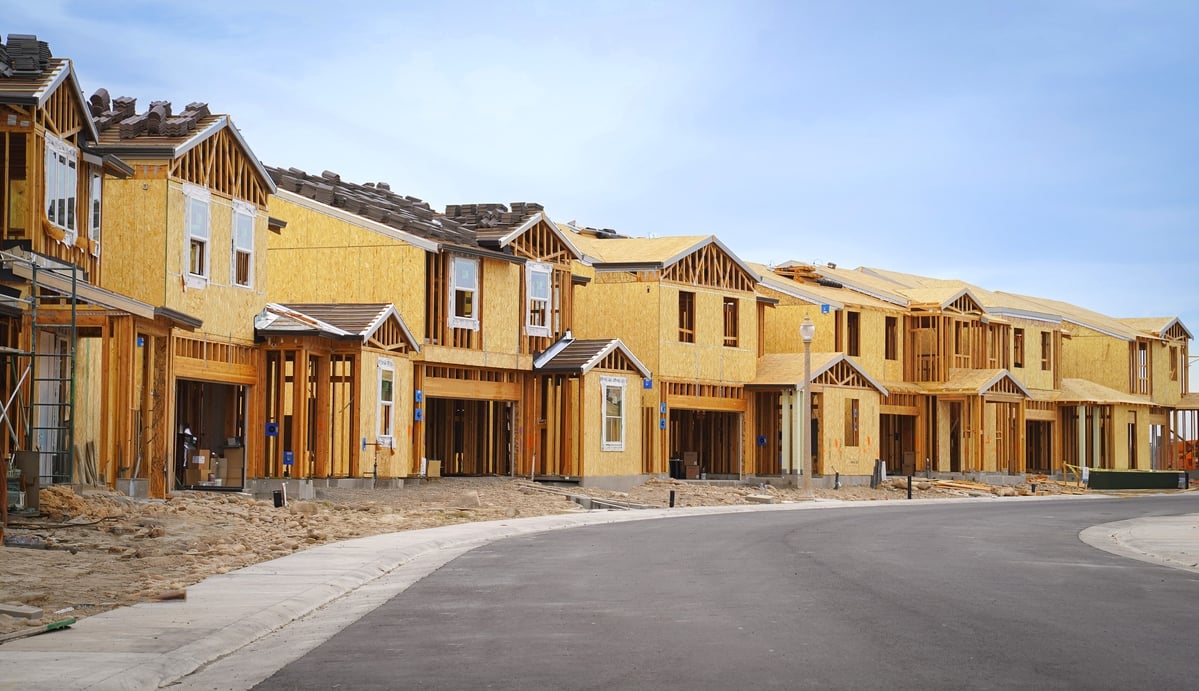
With operations in 126 markets across 36 states, D.R. Horton is the leading homebuilder in the United States. It mainly builds single-family detached homes (87% of home sales revenue) and offers products to entry-level, move-up, luxury buyers, and active adults. The company offers homebuyers mortgage financing and title agency services through its financial services segment. D.R. Horton's headquarters are in Arlington, Texas, and it manages six regional segments across the United States.
The chart shows the growth of an initial investment of $10,000 in D.R. Horton Inc., comparing it to the performance of the S&P 500 index. All prices have been adjusted for splits and dividends.
Returns By Period
D.R. Horton Inc. (DHI) has returned -3.22% so far this year and 11.35% over the past 12 months. Looking at the last ten years, DHI has achieved an annualized return of 16.49%, outperforming the Benchmark (SPY), which averaged 12.23% per year.
DHI
1M-7.72%
6M-20.54%
YTD-3.22%
1Y11.35%
5Y8.26%
10Y16.49%
Benchmark (SPY)
1M-3.85%
6M-2.35%
YTD-4.36%
1Y34.06%
5Y9.80%
10Y12.23%
Monthly Returns
The table below presents the monthly returns of D.R. Horton Inc. (DHI) with color gradation from worst to best to easily spot seasonal factors.
Jan
Feb
Mar
Apr
May
Jun
Jul
Aug
Sep
Oct
Nov
Dec
2026
3.12%
7.46%
-12.53%
2.02%
2025
0.38%
-9.33%
0.10%
-1.39%
-6.64%
10.20%
11.13%
15.14%
1.07%
-12.25%
7.01%
-8.02%
2024
-4.66%
3.00%
10.07%
-13.29%
3.87%
-4.65%
27.13%
4.05%
1.04%
-11.98%
-1.55%
-16.84%
2023
8.88%
-5.63%
6.10%
12.84%
-2.55%
13.32%
4.46%
-5.99%
-9.86%
-1.74%
22.08%
18.73%
2022
-17.32%
-4.93%
-12.48%
-8.00%
8.43%
-12.14%
16.67%
-8.48%
-4.31%
11.48%
9.55%
2.47%
2021
10.92%
-0.75%
13.66%
9.15%
-4.34%
-6.50%
5.42%
-0.98%
-12.28%
5.91%
9.37%
11.36%
2020
11.80%
-10.32%
-36.83%
44.80%
20.64%
-0.13%
19.08%
7.00%
5.82%
-12.91%
8.51%
-7.65%
2019
12.59%
0.88%
5.64%
6.59%
-4.15%
1.03%
5.03%
7.05%
7.24%
-0.46%
5.43%
-4.58%
2018
-4.52%
-13.54%
4.03%
1.19%
-4.07%
-3.39%
7.16%
1.27%
-5.15%
-14.91%
3.25%
-7.97%
2017
7.94%
6.67%
3.35%
-1.50%
-0.97%
5.53%
2.26%
1.09%
10.12%
9.51%
14.71%
0.24%
2016
0.07%
0.92%
3.76%
4.45%
-2.32%
-5.95%
-4.09%
-3.85%
-1.44%
Performance Indicators
The charts below present risk-adjusted performance metrics for D.R. Horton Inc. (DHI) and compare them to a Benchmark (SPY). These indicators evaluate an investment's returns against its associated risks.
Sharpe ratio
Sortino ratio
Omega ratio
Calmar ratio
Martin ratio
sharpe ratio
The Sharpe ratio helps investors understand how much return they're getting for the level of risk taken. A higher Sharpe ratio indicates better risk-adjusted performance, meaning more reward for each unit of risk.
These values reflect how efficiently the investment has delivered returns relative to its volatility over different time periods. All figures are annualized and based on daily total returns.
The chart below shows the rolling Sharpe ratio of DHI compared to the benchmark. This view highlights how the investment's risk-adjusted performance has changed over time.
Volatility Chart
The current D.R. Horton Inc. volatility is 1.95%, representing the standart deviation of percentage change in the investments's value, either up or down over the past month. The chart below shows the rolling one-month volatility.
Drawdowns Chart
The Drawdowns chart displays portfolio losses from any high point along the way. It shows the maximum percentage drop from a peak to a trough over a specified period, indicating the risk of significant losses. Although chart shows positive values, it represents the percentage drop from the peak, so a value of 10% means the portfolio has dropped 10% from its highest point.
Income Statement
The income statement provides a summary of a company's revenues, expenses, and profits over a specific period. It shows how much money the company earned (revenues) and how much it spent (expenses), leading to the net income or profit. This statement is crucial for understanding a company's financial performance and profitability.
2025
2024
2023
2022
2021
2020
2019
2018
2017
2016
2015
2014
2013
2012
2011
2010
Liabilities And Equity (USD)
35.47B
36.10B
32.58B
30.35B
24.02B
18.91B
15.61B
14.11B
12.18B
11.56B
11.15B
10.20B
8.86B
7.25B
5.36B
5.94B
Equity Attributable To Parent (USD)
24.19B
25.31B
22.70B
19.40B
14.89B
11.84B
10.02B
8.98B
7.75B
6.79B
5.89B
5.12B
4.06B
3.59B
2.62B
2.61B
Equity Attributable To Noncontrolling Interest (USD)
Markets rallied sharply on Monday following President Trump's announcement of a five-day halt to U.S. military strikes on Iranian energy infrastructure and claims of productive peace talks, despite Iran's swift denial of any negotiations. The S&P 500 gained 1.64%, with stocks hardest hit by the Middle East conflict—particularly cruise operators, airlines, and homebuilders—experiencing the strongest rebounds. Gold miners and construction-related ETFs also performed well amid the relief rally.
Benzinga•Piero Cingari
AI Insight
Homebuilder gained 4.45% on Monday as the homebuilding sector rebounded, having declined 17% month-to-date.
U.S. mortgage rates jumped to a three-month high of 6.22% following the Iran conflict, which increased oil prices and inflation expectations. The 10-year Treasury yield rose to 4.26%, while mortgage applications fell 11% and new home sales dropped significantly. President Trump signed an executive order to ease mortgage regulations and modernize home-buying processes.
Benzinga•Tanya Rawat
AI Insight
Home builder facing headwinds from rising mortgage rates and declining new home sales (down 18% in January), which reduces demand for new construction.
January's CPI report came in below expectations at 2.4% headline inflation, the lowest since May 2025, triggering a market rotation from mega-cap tech into rate-sensitive sectors. With shelter costs decelerating and core goods prices flat, investors are positioning for potential Fed rate cuts as early as June 2026. Homebuilders, REITs, and small-cap stocks are the primary beneficiaries of this shift.
Investing.com•Jaachi Mbachu, Aci
AI Insight
Largest homebuilder by volume with strong Q1 earnings beat, trading at 15.3x trailing earnings (market discount), positioned to benefit from falling rates and Trump administration's affordable housing initiatives. Analyst targets suggest 16% upside potential.
The timing and economic backdrop of Federal Reserve rate cuts will significantly impact bank stocks and homebuilders. Rate cuts driven by stable inflation could benefit both sectors through improved loan demand and mortgage affordability, but cuts triggered by economic weakness could increase credit risk for banks and limit housing demand. The yield curve shape and economic indicators like inflation, employment, and mortgage rates will be critical in determining whether these rate-sensitive sectors emerge as beneficiaries or face continued pressure.
Benzinga•Hillary Remy
AI Insight
DHI stands to benefit from lower mortgage rates improving affordability and unlocking pent-up demand. With constrained housing supply, the company may regain pricing power if demand recovers faster than supply.
President Trump announced a $200 billion mortgage bond purchase program through Fannie Mae and Freddie Mac to lower mortgage rates, which have reached their lowest level in three years at 6.06%. The article identifies D.R. Horton and Opendoor Technologies as potential beneficiaries, as lower mortgage rates typically boost demand for new homes and home flipping activities.
The Motley Fool•Jeremy Bowman
AI Insight
As the nation's largest homebuilder focusing on lower-priced homes and first-time homebuyers, D.R. Horton stands to benefit significantly from lower mortgage rates, which reduce monthly payments and increase affordability. The company can also benefit from rising home prices driven by lower rates.
Investor Steve Eisman believes Trump's $200 billion mortgage-backed securities purchase plan could spark a short-term rally in homebuilder stocks, particularly Lennar and D.R. Horton. Lower mortgage rates (down to 6%, potentially to 5.5%) could boost home sales, though Eisman notes the plan won't address deeper housing supply constraints at the local level.
Benzinga•Vishaal Sanjay
AI Insight
Eisman highlighted DHI as a key beneficiary of lower mortgage rates, noting its low valuation and potential for outsized gains. The stock showed positive YTD performance (+7.03%) and is positioned to benefit from falling rates.
Invitation Homes (NYSE:INVH) acquired ResiBuilt Homes for $89 million plus up to $7.5 million in earn-out payments to strengthen its build-to-rent strategy in the Southeast. The deal includes 23 existing fee-building contracts and options for 1,500 lots. However, the company faces headwinds from President Trump's proposal to block large institutional investors from buying single-family homes.
Benzinga•Akanksha Bakshi
AI Insight
Mentioned as a comparable major homebuilder in the market context, but no specific news or developments directly impact the company in this article.
The author explains why Lennar is a long-term hold despite Berkshire Hathaway's apparent short-term housing bet. He cites personal ownership of a Lennar-built home, the company's innovative land-light business model achieved through the Millrose Properties spinoff, and strong operational execution as reasons for indefinite ownership.
The Motley Fool•Matt Dilallo
AI Insight
Mentioned only as context for Berkshire's housing sector activity. Berkshire purchased and subsequently exited its position, suggesting a short-term tactical bet with no particular endorsement.
Elon Musk, who previously purchased a Boxabl home, is now exploring a potential partnership with Boxabl to design and build 'Micromenity' buildings for Tesla Supercharger locations, potentially expanding amenities for electric vehicle charging stations.
Benzinga•Chris Katje
AI Insight
Mentioned as having a deal with Boxabl, but no specific details or impact discussed